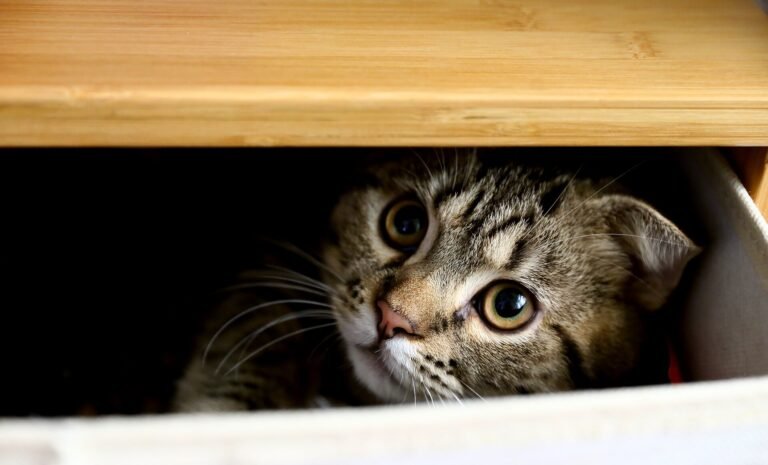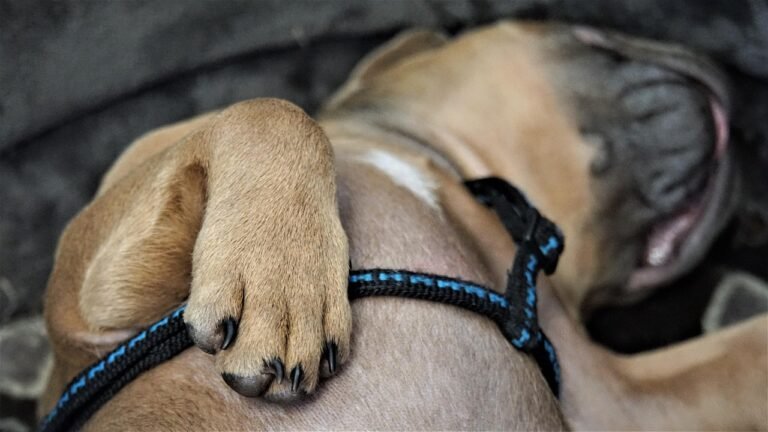
He used to take the stairs two at a time. Now he stands at the top and looks down, front paws on the edge, then backs away and lies down on the landing. You call him, you rattle the lead, you go halfway down and wait. Eventually you carry him, and you both feel ridiculous.
There are two very different reasons a dog stops using the stairs, and they need opposite responses. One is fear: something about the stairs has become frightening. The other is pain: the stairs have started to hurt. Coaxing a frightened dog gently is right. Coaxing a dog in pain is not, because the stairs are telling him something true. The first job is to work out which you have.
The short version
- A dog who used to manage stairs and now refuses needs a vet check before any training. The AKC’s chief vet lists “difficulty going up stairs or jumping onto a bed or couch” as a sign of arthritis.
- Arthritis is “most commonly seen in older dogs”, but sudden reluctance can also follow an injury, so age is not the only clue.
- Puppies often hesitate at stairs during normal fear periods, around 8 to 11 weeks and again at 6 to 14 months.
- Fear is fixed slowly, one step at a time, with treats, below the point where he panics. Never drag, push or force.
- Slippery treads and poor lighting make stairs harder for any dog, frightened or sore.
On this page
Fear or pain: which is it?
| What you see | More likely |
|---|---|
| Older dog, slower to stand up, reluctant to jump on the sofa too | Pain, often arthritis |
| Started after a slip, a fall, or rough play | Injury, possibly fear of the place as well |
| Fine going up, refuses to come down | Either. Coming down is often the harder direction, so check for pain first. |
| Puppy who was fine last week and now hesitates at new things | A normal fear period |
| Ears back, crouching, trying to retreat, tail tucked | Fear |
| Stiff, careful steps, licking a leg or joint, limping afterwards | Pain |
| Hesitates in dim light, or bumps into things elsewhere | Possibly eyesight |
The overlap matters. A dog who slipped and hurt himself can end up both sore and afraid. Treat the pain first. Fear training on a dog who is still hurting just teaches him that you ignore what the stairs feel like.
When the stairs hurt
Writing for the American Kennel Club, Randa Kriss lists the signs of arthritis given by Dr Jerry Klein, the AKC’s chief veterinarian. They include “difficulty or reluctance to stand from a lying position”, “difficulty going up stairs or jumping onto a bed or couch”, a narrow stance in the back legs and “wasting away of muscles in the rear limbs”. Arthritis is “most commonly seen in older dogs”, and the article is clear on the first step: take your dog to your vet, who can diagnose it and build a management plan.
If your dog has stopped using stairs, also look at whether he has stopped jumping into the car, onto the sofa or onto the bed. Several “I don’t want to” moments together usually point to pain rather than fear. A vet visit before any training is the right order, not an optional extra.
While you wait for the appointment, do not make him use the stairs. Carry a small dog, block the stairs with a gate, or keep him downstairs with his bed and water. Pushing a sore dog through pain is how one painful step turns into lasting fear.
Puppies and young dogs
A puppy who balks at stairs he has never used is not unusual, and stairs are big, steep and noisy from a puppy’s height. Many puppies also go through fear periods, when things that were fine last week suddenly look alarming. Sassafras Patterdale, a certified trainer writing for the AKC, places the first fear period around 8 to 11 weeks and a second around 6 to 14 months, with small breeds tending to hit it earlier.
Her advice applies directly to stairs: let the puppy move away from the scary thing, let him decide how close to get, reward curiosity such as looking, stepping closer or sniffing, keep sessions short and end on a good note. And her warning: forcing a puppy towards what frightens him “is far more likely to backfire”. In her words, “there are no shortcuts through a fear period.”
With a young puppy, keep the experience small: carry him on long flights, and teach stairs on a short run of two or three steps first.
If your older puppy has suddenly become wary of several things at once, it may be the adolescent stage rather than the stairs themselves. Our guide to adolescent dog behaviour regression covers that period.
The step by step plan for a fearful dog
Once a vet has ruled out pain, the method is the one used for any fear: small exposure, something good, and never past the point where he panics. Stephanie Gibeault, writing for the AKC, describes the aim as creating “positive associations for your dog with the things that frighten them”, keeping him “below threshold”, and accepting that “fear interferes with learning, so it can take your dog longer than expected”.
- Start at the bottom, not the top. Going up is usually easier and less frightening than coming down. Begin with the bottom step.
- Treats near the stairs. Scatter a few treats on the floor at the foot of the stairs. Let him eat them. That is the whole session at first.
- One step, front paws only. Put a treat on the first step. Let him put his front paws up to reach it. Praise, then let him step off.
- All four paws on the first step. Then the second step. Then the third. Stop each session while he is still keen.
- Downwards, the same way. Start him on the bottom step facing down, with a treat on the floor. Then from the second step. Build up the descent from the bottom, never from the top.
- Use a harness if he is steady enough. A harness lets you support him gently without pulling his neck, and helps if he wobbles.
- Short, frequent, boring. A few minutes, once or twice a day, ending on success. Expect it to take days or weeks.
Watch for the early signs that he is getting close to his limit. Gibeault mentions yawning, losing interest in treats and sniffing the ground as signs of discomfort before a dog becomes overwhelmed. If you see them, go back a step.
Making the stairs easier
Grip. Bare wooden or tiled stairs are slippery. Stair treads or a runner make a big difference to a dog who has slipped before.
Light. Make sure the stairs are well lit, especially at night, and especially for older dogs.
Open risers. Some dogs dislike stairs they can see through. Covering the gaps temporarily can help.
A gate. If he should not use the stairs, a baby gate takes the decision out of it, and stops him attempting them when you are not there.
Live downstairs for a while. If he is recovering, moving his bed downstairs is often kinder than daily carrying.
What makes it worse
Dragging or pushing. Pulling on the lead or pushing from behind turns a worry into a fight and teaches him the stairs are where bad things happen.
Ignoring pain. Training a sore dog to use stairs he finds painful is the wrong fix entirely.
Punishment or frustration. Gibeault’s guidance is to use positive methods only and to ignore and redirect rather than punish.
Going too fast. Three good steps today is not a reason to try the whole flight. Progress at his pace.
Common questions
Why is my dog suddenly scared of the stairs?
Usually either pain or fear. Older dogs often develop arthritis, and difficulty with stairs is one of its signs. A slip or fall can create both soreness and fear. A vet check comes first, then gradual training if pain is ruled out.
My dog will go up the stairs but not down. Why?
Coming down is often the harder direction. Check for pain first. If he is healthy, train the descent from the bottom step upwards, one step at a time, with treats on the floor below.
Is it normal for a puppy to be scared of stairs?
Yes, especially during fear periods, which the AKC places around 8 to 11 weeks and again between 6 and 14 months. Let him go at his own pace, reward curiosity, and never force him.
Should I carry my dog up and down the stairs?
For small dogs, young puppies, or dogs in pain, carrying is sensible in the short term. For a fearful but healthy dog, carrying avoids the problem without solving it, so pair it with gradual step training.
When should I take my dog to the vet about stairs?
Whenever a dog who used to manage stairs starts refusing them, especially if he is older, slower to stand up, reluctant to jump, stiff or limping. The AKC’s guidance on arthritis puts a vet diagnosis first.
The bottom line
A dog who stops using the stairs is either frightened or sore, and the answer depends on which. If he is older, slower to get up, or has stopped jumping onto things too, go to the vet first and keep him off the stairs meanwhile. If he is healthy, build the stairs back one step at a time, starting from the bottom, with treats and short sessions that end on success. Add grip and light, never drag or push, and let him set the pace.
Sources
- Kriss R, with Dr Jerry Klein, AKC Chief Veterinarian, for the American Kennel Club. How to manage the symptoms of canine arthritis: signs including difficulty with stairs, and diagnosis by a vet as the first step.
- Patterdale S, CPDT-KA, for the American Kennel Club. Puppy fear periods: typical ages, what they look like, and what to do and avoid.
- Gibeault S, MSc, CPDT, for the American Kennel Club. How to train a fearful dog: desensitisation and counterconditioning, keeping below threshold, early signs of discomfort, and positive methods only.