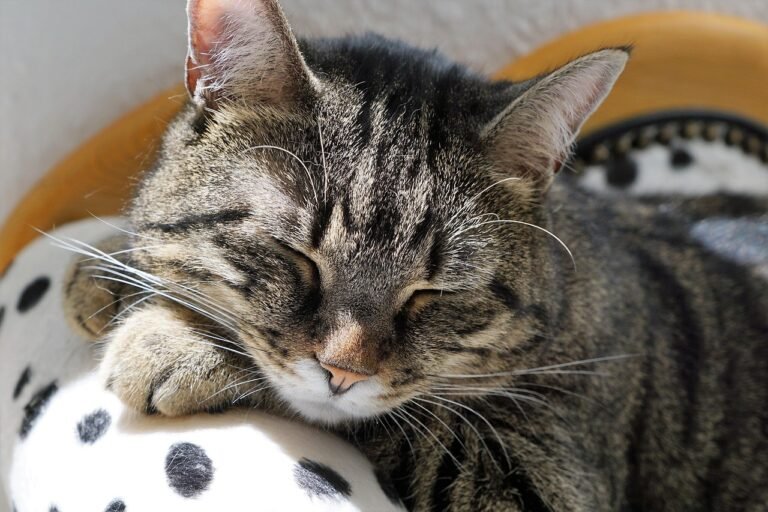
You get about four strokes. The first two are fine, she even leans into the second one, and then the skin along her back starts to twitch, the tail goes, and the third stroke ends with her teeth around your wrist and the brush on the floor. So you give up, and a month later there is a mat behind her ear the size of a walnut.
The reason this keeps happening is that almost everyone is trying to do a full groom. A whole cat, in one sitting, with a cat who has already told you where her limit is. The way out is the opposite: much shorter sessions, ending before she objects rather than when she objects, repeated daily. Sixty seconds a day beats a ten minute wrestle once a week, and it beats it by a wide margin.
The short version
- International Cat Care recommends grooming longhaired cats “at least daily but only do this for as long as your cat is comfortable”. That second half is the part people skip.
- Stop before she complains, not when she complains. The early signs are skin twitching, tail swishing, turning her head towards the brush, freezing and ear flicking.
- Never cut a mat out with scissors. The VCA guidance is explicit: “Only use clippers to remove mats, never scissors.” Cat skin is thin and lifts with the mat, and the cut goes into skin more often than people expect.
- Build the habit in seconds, not minutes: one stroke, food, stop. Then two strokes. Over a couple of weeks this becomes a cat who comes when she sees the comb.
- Work from the parts she likes towards the parts she does not. Cheeks and chin first. Belly, back legs and tail last, if ever.
- A cat who has stopped grooming herself is not being lazy. That is usually pain, arthritis or weight, and it is a vet question.
On this page
Why she objects
It is rarely the brushing itself. It is usually one of these five, and they need different answers.
| The real objection | How you know |
|---|---|
| It hurts | She is fine on the shoulders and reacts over the spine, hips or belly. A mat being tugged, or arthritis underneath, and both are common in older cats. |
| Being held | She tolerates the brush while free but fights the moment you hold her. The restraint is the problem, not the comb. |
| Sensitive areas | Belly, back legs, tail base and armpits are defended in most cats. These are also exactly where mats form. |
| Too long | The first strokes are fine and it goes wrong at a predictable point. She is not refusing grooming, she is refusing the fourth minute of it. |
| The tool | A slicker brush with sharp pins on a thin-skinned cat is uncomfortable. Many cats who hate a brush are fine with a metal comb or a rubber mitt. |
Work out which one you have before you start a training plan, because if the answer is pain, no amount of patient desensitisation will fix it and you will just teach her that you ignore her warnings.
Why the mats matter more than you think
A mat is not a cosmetic issue. It is a knot of hair tightening against skin, and it pulls every time she moves. Left alone, the skin underneath gets sore, damp and sometimes infected, and the cat starts avoiding being touched anywhere near it, which makes the next groom harder. That is the loop.
The spots to check weekly, with your fingers rather than your eyes: behind the ears, under the chin, the armpits, the belly, the back legs, and the base of the tail. The VCA guidance specifically flags ears, armpits and back legs as where mats form on longhaired cats.
Do not cut mats out with scissors. This is the most common way owners injure their cats at home. A mat pulls the skin up into a tent with it, so the skin sits inside what looks like a clump of fur. VCA’s rule is blunt: “Only use clippers to remove mats, never scissors.” If a mat is tight to the skin, it is a job for a vet or a cat groomer, sometimes under sedation.
Daily combing also removes the loose hair she would otherwise swallow, which is the practical link between grooming and hairballs. Our guide to how often hairballs are normal covers when that crosses from ordinary into a reason to call the vet.
The tool is half the battle
Buying the right thing solves a surprising proportion of grooming refusals.
For longhaired cats: a metal comb with long, rounded-tip teeth, ideally with two tooth spacings. VCA recommends long-toothed metal combs with offset tines for medium and longhaired breeds. The comb reaches the undercoat, which is where mats begin. A brush that only skates over the top layer leaves the problem forming underneath while the cat looks beautifully groomed.
For shorthaired cats: a soft bristle brush or a rubber grooming mitt. A mitt is usually the easiest sell, because it feels like being stroked.
Avoid: cheap slicker brushes with sharp uncoated pins, and any “mat breaker” with blades unless you are confident and the mat is loose. Both hurt, and one bad session costs you weeks.
Check your own technique: support the hair at the root with your free hand as you comb through, so the pull lands on your fingers rather than her skin. This single change turns a lot of grooming refusals around.
The two week plan
The principle is desensitisation and counterconditioning, the same method used for any fear: keep the exposure small enough that she never reacts badly, and pair it with something excellent. VCA describes it as exposing the animal at “a very low level, so that your pet does not experience fear”, paired with favoured rewards.
Practically, that means starting far below what you think is reasonable.
- Days 1 to 2: the comb exists. Put the comb on the floor near her. Do not groom. When she looks at it or sniffs it, food. Three or four repetitions, twice a day. You are paying her for noticing the object.
- Days 3 to 4: one touch. Touch the comb to her shoulder, no stroke. Immediately food. Remove the comb. That is the whole session, about five seconds. Repeat a few times a day.
- Days 5 to 7: one stroke. One stroke over the cheek or the shoulder, then food, then stop. Stop while she still wants more. This is the hardest instruction in the article and it is the one that makes it work.
- Days 8 to 10: build strokes. Two strokes, then three, always in the easy zones, always ending before any of the warning signs below. If you get a tail swish, you have gone one stroke too far, so do one fewer next time.
- Days 11 to 14: extend the map. Keep the sessions short and start adding the less popular areas at the end of a good session, one or two strokes only: down the flank, then the back legs, then the belly if she allows it. International Cat Care’s instruction is to end “before your cat shows any signs of discomfort”.
- Then: sixty seconds, daily, forever. A minute a day on a longhaired cat prevents most mats. It is also short enough that you will actually do it.
Groom where she already relaxes, not on a table. Most cats do best on the sofa, or on a windowsill, or wherever she naturally settles. Choose a sleepy moment rather than the ten minutes after dinner when she is looking for a game. And if she walks away, let her. A cat who is never trapped comes back sooner.
Her early warning signs
International Cat Care lists the signals that a cat is not enjoying it: skin twitching, tail swishing, turning the head towards the brush, freezing, ear flicking, growling, hissing. The first four are the ones worth learning, because by the time you get a growl you have already lost the session.
| What you see | What it means | What to do |
|---|---|---|
| Leaning in, cheek pushing against the comb, purring | Enjoying it | Carry on, and still stop early |
| Skin rippling along the back, tail tip flicking | First warning. She is tolerating, not enjoying. | One more stroke at most, then food and stop |
| Freezing, head turning towards the comb, ears flicking back | She is about to object | Stop now. End on food so the session still finishes well. |
| Growling, hissing, grabbing your hand, biting | Over the line | Stop, let her go, and go back two stages tomorrow. Do not tell her off. |
A cat who finds that her small signals are respected stops needing the large ones. That is the whole trick, and it is why this approach ends up faster than the one that looks faster.
If she is already matted
Training and detangling are two different jobs. Do not try to do them in the same session, because the detangling hurts and it will poison the training.
- Assess by feel. A loose tangle moves when you lift it and you can get a finger between it and the skin. A mat that is tight to the skin does not move. Those are two different problems.
- Loose tangles: International Cat Care’s advice is to tease them apart gently with your fingers, working from the root outwards, before you go near them with a comb. Hold the hair above the tangle so the pull does not reach the skin.
- Tight mats: hands off. A vet or an experienced cat groomer with clippers, sometimes with sedation for a bad case. International Cat Care notes that severe matting may need professional grooming or veterinary help under sedation, because scissors risk cutting the skin.
- Afterwards, start the daily minute. A cat who has been shaved out is a clean slate. Most owners get one comfortable coat and then let it happen again, because nothing changed in the routine.
Sedation worries people, and that is reasonable, but weigh it against the alternative. A badly matted cat is in constant discomfort, the skin underneath can be inflamed or infected, and every failed home attempt teaches her that hands near her coat mean pain. A vet can assess the risk for your particular cat, which is a conversation worth having rather than guessing at.
When it is a health problem
Two situations need a vet rather than a plan.
She has stopped grooming herself. A cat who was well kept and now has a greasy, clumpy or dandruffy coat is telling you something. VCA notes that older, arthritic or overweight cats may struggle to groom themselves, and that excessive shedding, dull coat, dandruff or greasiness are signs worth a veterinary look. A cat who cannot turn to reach her back is not a grooming problem, she is a pain problem with a grooming symptom.
She reacts in one specific place only. Consistent objection over one area, while she is happy everywhere else, points to something under the skin rather than something about brushes. That is worth a hands-on examination.
Overgrooming is the other end of the same subject, a cat who licks a patch bare rather than avoiding the brush. That is usually skin disease, parasites, pain or stress, in roughly that order of frequency, and it needs a vet rather than a behavioural guess.
Common questions
How do I brush a cat that hates being brushed?
In much shorter sessions than you think. Start by rewarding her for looking at the comb, then one touch, then one stroke, always ending with food and always stopping before she objects. Build up over about two weeks to a minute a day.
How often should I groom my cat?
International Cat Care suggests at least weekly for shorthaired cats and at least daily for longhaired cats, with the important qualifier that you groom only for as long as your cat is comfortable.
Can I cut a mat out with scissors?
No. A mat lifts the skin with it, so the skin often sits inside what looks like fur. The VCA guidance is to use clippers rather than scissors, and tight mats are best handled by a vet or a cat groomer.
What brush is best for a cat who hates grooming?
For longhaired cats, a metal comb with long, rounded teeth that reaches the undercoat. For shorthaired cats, a rubber mitt or soft bristle brush. Sharp-pinned slicker brushes are a common reason cats object.
Why does my cat bite me after a few strokes?
Usually because the session ran past her limit and the earlier signals, skin twitching and tail swishing, were not acted on. Cut the session to fewer strokes than the point where she objects, then build slowly from there.
My cat has stopped grooming herself. Is that lazy?
No. It is usually arthritis, weight or dental pain making self-grooming difficult or painful. A coat that has become greasy, dull or clumpy is a reason to see a vet.
Should I get a professional groomer for my cat?
For a badly matted coat, yes, or a vet. Choose someone experienced with cats specifically, since cat skin and cat handling are not the same job as dogs.
The bottom line
She does not hate grooming, she hates the length of the session and the places you finish it. Buy a comb that reaches the undercoat, check the mat spots weekly with your fingers, and rebuild the habit in seconds: comb appears, food, stop. Then one stroke, food, stop. Respect the skin twitch and the tail flick, end every session while she still wants more, and aim for a minute a day rather than ten minutes a week. Never take scissors to a mat, and if she has stopped grooming herself, see the vet before you buy another brush.
Sources
- International Cat Care. Grooming your cat: at least weekly for shorthaired and at least daily for longhaired cats, signs a cat is uncomfortable, ending sessions before discomfort, and professional or veterinary help for severe matting.
- Barnes C, Llera R, Hunter T, Yuill C, for VCA Animal Hospitals. Grooming and coat care for your cat: mat locations, “only use clippers to remove mats, never scissors”, recommended tools, and coat changes worth a veterinary check.
- VCA Animal Hospitals. Overcoming fears with desensitization and counterconditioning: low level exposure paired with favoured rewards.