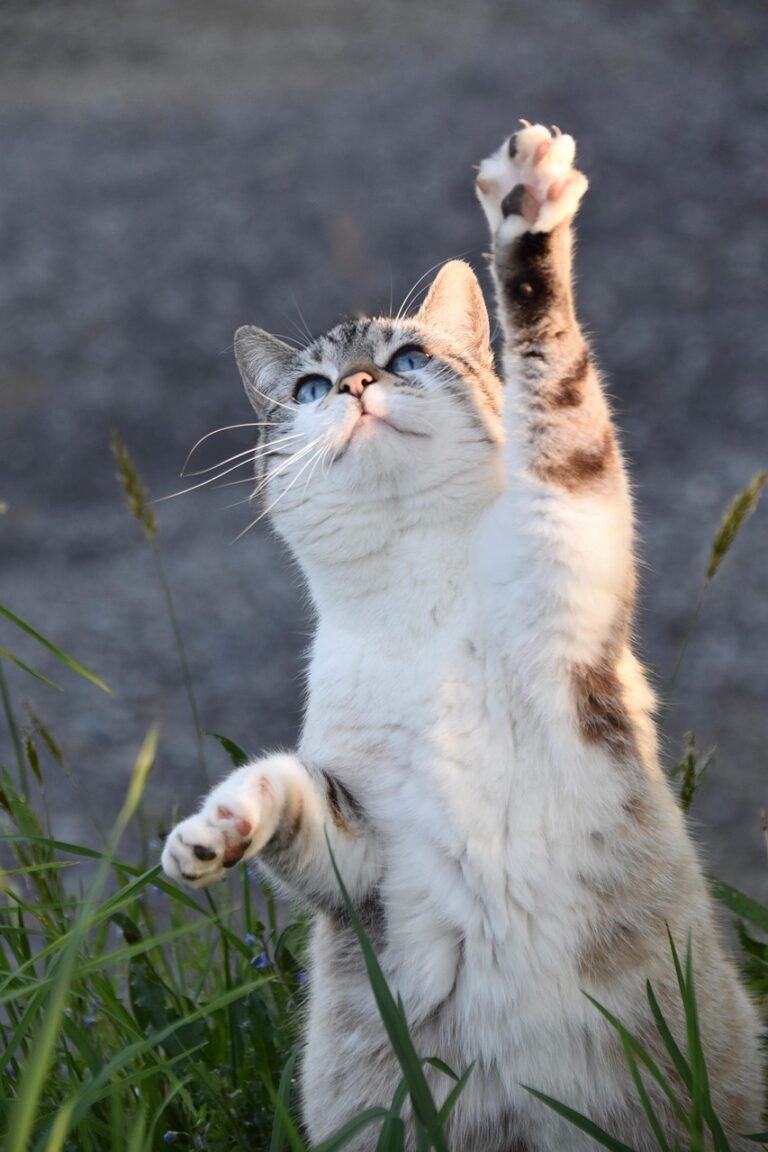
It starts on the landing. One cat pounces, the other rolls, there is a blur of legs and a thump against the skirting board, and then they are both sitting two metres apart staring at each other. You are standing in the doorway with a cushion in your hand, trying to work out whether to throw it.
Most owners have no reliable way to tell. And the honest answer is that cats themselves are not always on the same page: some interactions start as play and drift into something else, and some are neither one thing nor the other. Researchers in 2023 watched 105 video clips of 210 cats interacting and found exactly that. Most of what they saw was play. A substantial share was fighting. And a meaningful slice sat in between.
That middle group is the useful part, because it is where you can still step in before anything goes wrong.
The short version
- In the 2023 study, 56.2 percent of cats were in playful interactions, 28.6 percent in fighting and 15.2 percent in an intermediate group.
- The clearest sign of play is reciprocal wrestling: they take turns, swap who is on top and who chases.
- The clearest sign of fighting is noise. Vocalisation was the strongest marker of agonistic interactions, followed by chasing.
- Look for the pause. Fighting cats break off and stay apart, staring. Playing cats pause and go back in.
- One bad scrap does not ruin a relationship. Cats who still groom each other and sleep together are usually fine. Repeated tension is what needs action.
- If you need to break it up, use a calm distraction or a barrier, never your hands.
On this page
What the study actually found
Gajdoš-Kmecová and colleagues, publishing in Scientific Reports in 2023, coded the behaviour in 105 video clips covering 210 cats and let the statistics group the interactions rather than deciding the categories in advance. Three clusters came out.
| Cluster | Share of cats | What characterised it |
|---|---|---|
| Playful | 56.2 percent | Wrestling, especially reciprocal wrestling where the roles reverse |
| Intermediate | 15.2 percent | Longer exchanges with pauses, pouncing, stalking, approaching, lying belly up, mutual grooming, play invitations that are not returned |
| Agonistic (fighting) | 28.6 percent | Vocalising and chasing, long breaks between bouts, less direct body contact |
Two findings stand out for anyone watching their own cats. The first is that wrestling, the thing that looks most alarming, was most closely associated with play, not fighting. The second is that vocalisation was the strongest single marker of a real fight. Cats who are playing are usually quiet.
The authors’ own summary is the best test to carry around: “The more reciprocal the interaction is without agonism, then the closer the interaction is to true mutual social play.”
The side by side checklist
The study gives you the two strongest markers. In a piece for The Conversation explaining the research, the team adds the detail: in play, cats move towards each other “in relaxed and exaggerated ways”, claws stay “sheathed” and bites are “inhibited”. In a fight you see growling or hissing, “enlarged pupils, prolonged staring” and real use of claws and teeth.
| Watch for | Usually play | Usually a fight |
|---|---|---|
| Sound | Silent, or the odd chirp | Growling, hissing, yowling, screaming |
| Roles | They swap: chaser becomes chased, top becomes bottom | One cat always chases, one always flees |
| Bodies | Loose, bouncy, exaggerated movements | Stiff, low, fur raised, ears flattened or turned back |
| Claws and teeth | Claws mostly in, bites gentle and brief | Claws out, bites held, fur coming loose |
| Pauses | Short, then one invites the other back | Long, with staring from a distance |
| Afterwards | Groom, wander off, or sleep near each other | Avoid each other, one hides, guarding of doors or food |
Do not rely on a single sign. A playing cat can growl once. A fighting cat can be silent for a stretch. It is the pattern across the whole interaction, and across days, that tells you what is happening.
The middle zone
The intermediate group is the most useful finding in the paper, and the one most articles skip. These were longer exchanges, broken up by pauses, where one cat’s invitation to play was not returned, or one cat kept going after the other had clearly had enough.
The authors read this group carefully. They suggest it may reflect “a short-term disagreement in social behaviour between the cats, rather than a break-down in the relationship”. In plain terms: one cat wants to play and the other does not, and the first one is not taking the hint.
Typical household version: a young cat and an older cat. The young one stalks and pounces, the older one swats, walks away, gets followed, swats again. Nobody is hurt. But it is not mutual, and if it happens every day it can turn into real tension, especially for the cat who keeps being pestered.
The fix for the middle zone is not to separate the cats. It is to give the energetic one somewhere else to put that energy. Two short wand-toy sessions a day aimed at the pouncer, plus a puzzle feeder, usually takes the pressure off the older cat within a week or two. Our guide to getting a cat to use a puzzle feeder covers the second part.
The question that settles most cases
Forget the thirty seconds on the landing for a moment, and look at the rest of their day. The study’s authors make the point that one agonistic encounter does not necessarily damage a relationship, and that occasional conflict between cats who also show friendly behaviours warrants less concern than sustained tension.
So ask: do they ever do any of these?
Groom each other. Mutual grooming is one of the clearest signs of a bonded pair.
Sleep touching, or in the same bed. Cats who are genuinely at odds do not choose to sleep against each other.
Rub against each other when passing. A shared scent is how cats mark each other as part of the same group.
Eat and use the tray without watching each other. No guarding, no waiting for the other to leave.
If the answer is yes to two or three of these, a noisy scrap now and then is almost certainly not a relationship problem. If the answer is no to all of them and the scraps are getting more frequent, you are dealing with tension, whatever the scraps look like.
What to do, case by case
| What you are seeing | What to do |
|---|---|
| Quiet, reciprocal wrestling, turns taken | Nothing. This is play, and it is good for them. |
| One cat keeps inviting, the other keeps leaving | Redirect the keen one with a toy, add daily play sessions, give the other cat high places and escape routes |
| Growling or hissing appearing in a play session | Calm interruption: a soft sound or a toy tossed nearby, as the researchers suggest. Let them separate on their own. |
| Noisy chasing, one cat cornered or hiding afterwards | Interrupt with a barrier such as a cushion or cardboard, never your hands. Separate for a cooling off period. |
| Real fights, injuries, or tension most days | Full separation and a structured reintroduction. Get both cats checked by a vet first. |
The researchers’ advice on interrupting is worth taking literally: when aggression appears, “divert the cats’ attention in a calm way”, for example with “a soft sound or by offering a toy at a short distance”. Shouting, spraying or grabbing adds fear to a situation that is already about fear.
Never reach in with your hands between two cats who are genuinely fighting. Cat bites are deep and abscess easily. A cushion, a folded blanket or a piece of cardboard put between them is safer for everyone.
If what you have is the last row in that table, the step by step plan is in our guide to reintroducing cats after a fight. And if the trouble started right after one cat came home from the clinic, read why a cat hisses at her housemate after the vet first, because the cause and the fix are different.
Common questions
How can I tell if my cats are playing or fighting?
Listen and watch the roles. A 2023 study of 210 cats found reciprocal wrestling, where the cats take turns, was most associated with play, while vocalisation and chasing were most associated with fighting. Quiet, turn-taking wrestling is play. Noisy, one-way chasing is not.
Is it normal for cats to play rough?
Yes. Wrestling, pouncing and bunny-kicking are normal play, and in the study wrestling was most closely linked to playful interactions. The signs that it has tipped over are sound, one cat always on the receiving end, and fur flying.
Should I stop my cats from play fighting?
Not if it is mutual and quiet. Step in calmly with a toy or a soft sound if you hear growling or hissing, or if one cat is clearly trying to leave and the other will not let it.
My cats fought once. Is their relationship ruined?
Usually not. The study’s authors note that a single agonistic encounter does not necessarily damage a relationship. If they still groom each other, sleep together or rub past each other, keep an eye on it rather than separating them.
Why does one cat always chase the other?
One-sided chasing is one of the markers the study associated with fighting rather than play. If it is constant, the chased cat is likely stressed. Give her escape routes and high places, keep the chaser busy with play, and watch whether the chased cat starts hiding or avoiding shared spaces.
How do I safely break up a cat fight?
Never with your hands. Make a sound, or put a cushion, blanket or piece of cardboard between them so they lose sight of each other, then let them separate. Keep them apart until both are calm.
The bottom line
Most cat interactions that look alarming are play. Listen first: quiet is play, growling and hissing is not. Then watch the roles: turns taken is play, one cat always chasing is not. Pay attention to the middle zone, where one cat wants to play and the other does not, because that is where you can fix things with a wand toy before it becomes a problem. And judge the relationship on the whole day, not the thirty seconds on the landing. Cats who groom each other and share a bed are almost always fine.
Sources
- Gajdoš-Kmecová N, Peťková B, Kottferová J, Halls V, Haddon C, Santos de Assis L, Mills DS. An ethological analysis of close-contact inter-cat interactions determining if cats are playing, fighting, or something in between. Scientific Reports, 2023;13:92. 105 videos, 210 cats; playful 56.2 percent, agonistic 28.6 percent, intermediate 15.2 percent.
- The Conversation. How to tell when cats are fighting or just playing: six important clues to watch out for. Plain-language summary of the study by the research team, including play and aggression signs and how to interrupt calmly.
- EurekAlert press release, January 2023. Cat-egorising play and genuine fighting in cats. Summary of the study and the authors’ comments on the intermediate group.