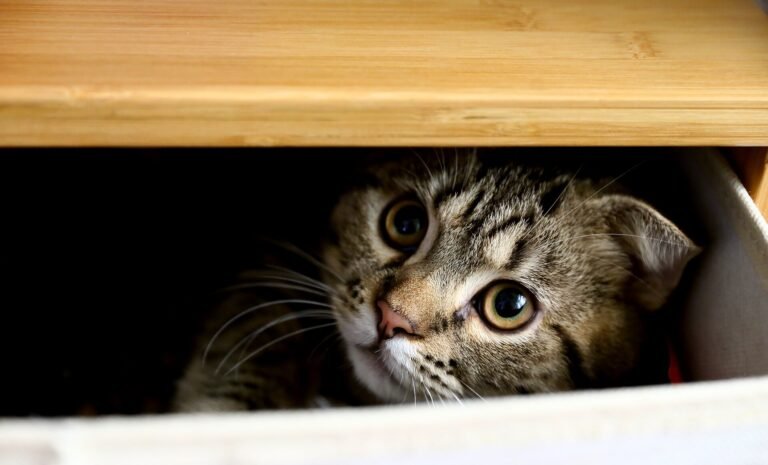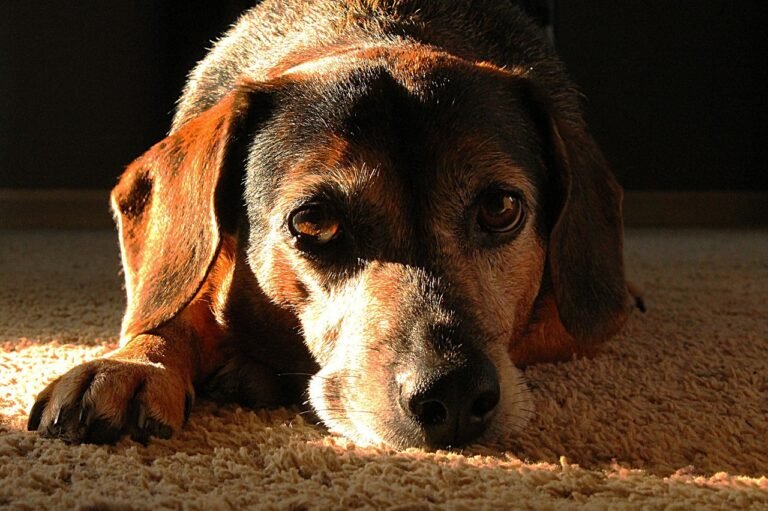
You get up to fill the kettle and he gets up too. You go to the bathroom and there is a nose under the door. You move from the sofa to the armchair, and thirty seconds later he has moved too, lying with his chin on your foot as if you might leave the country without him.
Most of the time this is simply a dog who likes you. Dogs are social animals, and following the person they are bonded to is normal. The question worth asking is not “why does he follow me” but “what happens when he cannot”. A dog who follows you everywhere and is relaxed when you leave the house is a companion. A dog who follows you everywhere and falls apart when you leave is a dog who has never learned that being alone is safe.
The difference decides whether you need to do anything at all.
The short version
- Following you around is normal for many dogs, and on its own it is not a problem.
- Dogs Trust lists following “from room to room” alongside being “unable to rest or settle” as possible signs of separation anxiety, but only as part of a wider pattern.
- The real test is what happens when you leave: barking, howling, destruction, toileting, pacing, or a dog waiting at the door the whole time you are out.
- Never punish a dog for what happens while you are out. Dogs Trust is explicit that dogs “don’t understand that being told off when you get home is about something they did hours earlier.”
- The fix for over-dependence is teaching him that resting while you move around is a good choice, starting with tiny steps at home, long before you leave the house.
On this page
Why dogs follow their people
Dogs evolved to live in groups, and puppies, as Dogs Trust puts it, “begin life living in a group”. Staying close to the people they rely on for food, safety and company is part of what makes dogs such good companions. Many also follow because things happen near you: food, walks, play, and attention all start wherever you are.
| Usual reason | What it looks like |
|---|---|
| Bond and habit | Follows you, lies down nearby, settles quickly. Fine on his own. |
| Something good is coming | Follows you into the kitchen, to the door, towards the lead. Interest, not worry. |
| Under-occupied | Follows because you are the only interesting thing in the house. Settles better after a proper walk or a chew. |
| Reinforced over time | Every time he followed you, he got a stroke or a word. Following became the way to get attention. |
| Worry about being left | Cannot settle, watches every move, gets up the moment you stand, distressed when a door closes between you. |
Only the last row is a problem in itself, though the others can become one if they grow into the last.
Normal or a problem: the test
Watch two things: how he behaves while you are home, and how he copes when you are not.
At home. Can he settle and actually sleep in another room while you are busy? Does he lie down when you sit, or stay standing and watching? Dogs Trust lists being “unable to rest or settle for long” as a warning sign.
When you get ready to leave. The ASPCA notes that anxious dogs may “seem anxious or depressed prior to their guardians’ departure” and “try to prevent their guardians from leaving”. Dogs Trust adds dogs who position “themselves between you and the front door”.
While you are out. Dogs Trust lists “barking, whining, whimpering or howling”, “trembling, panting, drooling”, and spending time “near the door you left through or looking out of windows”. The ASPCA adds toileting indoors, chewing and destruction, escape attempts and pacing.
The easiest way to find out what happens while you are out is to film it. A phone propped on a shelf or a cheap pet camera for the first twenty minutes after you leave tells you more than any checklist. A dog who sighs and goes to sleep is fine. A dog who stands at the door crying is not.
If he follows you at home but is calm on camera, you have an affectionate dog and nothing urgent to fix. If he follows you and also struggles when you leave, keep reading, and consider getting help early rather than waiting to see if it passes.
When it suddenly starts
A dog who was independent and has recently become a shadow is telling you something changed. The ASPCA and Dogs Trust both list the common triggers:
A change of routine. A new job, a return to the office after working from home, a change in schedule.
A move. New house, new smells, new sounds, nothing familiar.
A change in the household. Someone moving out, a new baby, a death in the family. Dogs Trust specifically mentions “losing a canine companion”.
A new home for him. Recently adopted dogs often stick close while they work out who is reliable. Our guide to the first week with a new dog covers what is normal in that period.
Health. Dogs Trust notes that some dogs with “hearing or vision” loss become “more dependent on you”. In an older dog, new clinginess is worth a vet check.
Teaching him to stay settled
The goal is not to stop him liking you. It is to teach him that lying down and resting while you move around is a good choice. Dogs Trust calls this “settle training”: teaching dogs that “resting when you’re busy is a good choice”, then gradually adding duration and slowly adding “movement like standing up and sitting again while your dog is busy”.
- Give him a settle spot. A comfortable bed in the room where you spend most time. Not a crate he is shut in, just a place that is his.
- Reward calm, not following. Drop a treat on his bed when he is lying there quietly. Say nothing when he trails you to the kitchen. Over time, the bed becomes where good things happen.
- Give him something to do there. A long-lasting chew or a stuffed food toy on his bed while you do something boring like answering emails. Lying down becomes the default.
- Add tiny movements. While he is busy, stand up and sit down again. Then take two steps away and come back. Then go to the kitchen and back. Build slowly, the way Dogs Trust describes.
- Add distance, then doors. Leave the room for a few seconds and come back calmly. Then with the door half-closed. A baby gate is useful here, because he can see you but cannot follow.
- Keep it boring. Leaving and coming back are non-events. The ASPCA advises against excess enthusiasm at greetings and goodbyes.
Exercise and enrichment carry a lot of the weight. A dog who has had a proper sniffy walk and something to chew is far more likely to choose sleep over surveillance. If he only switches off when he is exhausted, that is information too.
If he struggles when you leave
If filming shows distress when he is alone, this is beyond settle training on its own. The ASPCA describes the approach for moderate to severe cases as “a more complex desensitization and counterconditioning program” built on “graduated departures”, starting with “very short separations that do not produce anxiety”. It also notes a hard truth: during that programme, the dog ideally “cannot be left alone except during your desensitization sessions”, which usually means arranging a sitter, daycare or a friend for a while.
This is the point to involve professionals. Speak to your vet first, since medication is sometimes part of the plan and the ASPCA advises always talking to your vet before using any. Then look for a qualified behaviourist. The ASPCA recommends a Certified Applied Animal Behaviorist or a board-certified veterinary behaviorist. In the UK, Dogs Trust runs a free Behaviour Support Line on 0303 003 6666.
What makes it worse
Punishment. The ASPCA is direct: “Do not scold or punish your dog. Anxious behaviors are not the result of disobedience or spite.” Dogs Trust adds that a dog cannot connect a telling-off on your return with something that happened hours earlier.
Shutting him in a crate to solve it. For some anxious dogs, the ASPCA warns, “the crate can cause added stress and anxiety.” A crate he already loves can help. One he is confined in for the first time can make things worse.
Dramatic goodbyes and hellos. Long farewells and excited returns make your comings and goings bigger events than they need to be.
Pushing too fast. Jumping from five minutes alone to a full working day undoes progress. Build in small steps he can cope with.
Rewarding every follow. Strokes and chat every time he trails you teach him that following is how attention arrives. Save the attention for when he is settled.
Common questions
Why does my dog follow me everywhere?
Usually because he is bonded to you, and good things happen near you. Dogs are social animals, and following their person is normal. It is only a concern if he cannot settle when you are home or becomes distressed when you leave.
Is a dog following you everywhere a sign of separation anxiety?
It can be one sign, but not on its own. Dogs Trust lists following from room to room alongside being unable to settle, waiting by the door, and barking, howling or trembling when left. Look at the whole pattern, especially what happens when you leave.
Should I stop my dog following me?
Not if he is relaxed and copes well alone. If he cannot settle, teach him to rest on his own bed while you move around, rewarding calm rather than following, and build distance gradually.
Why has my dog suddenly become clingy?
Common triggers include a change of routine, a house move, someone leaving the household, the loss of another dog, or a recent adoption. In older dogs, sight or hearing loss can make them more dependent, so a vet check is sensible.
Should I punish my dog for destruction while I was out?
No. Both Dogs Trust and the ASPCA say not to punish separation-related behaviour. Dogs cannot connect a telling-off with something that happened earlier, and anxiety is not disobedience.
The bottom line
A dog who follows you from room to room is usually just a dog who likes you. What matters is whether he can switch off at home and cope when you leave. If he can, enjoy the company. If he cannot, teach him that his own bed is a great place to be while you move around, build distance in tiny steps, keep goodbyes boring, and film what happens when you go out. If that video shows real distress, bring in your vet and a qualified behaviourist rather than waiting for it to pass.
Sources
- Dogs Trust. Separation anxiety in dogs: signs including following from room to room and being unable to settle, causes, settle training, never punishing, and the Behaviour Support Line.
- ASPCA. Separation anxiety: signs, triggers, counterconditioning, graduated departures, crate cautions, not scolding or punishing, and when to see a behaviourist or vet.