
He comes over to the sofa the way he always has, sets himself up, and then doesn’t go. Shifts his weight. Looks at you. Lies down on the rug instead. Maybe he tries an hour later and makes it, and you decide it was nothing.
Almost everyone’s first explanation is age. He’s slowing down. He’s getting lazy in his old age. He can’t be bothered.
That sentence — “he’s just getting old” — is probably the most expensive one in dog ownership, and there’s now decent evidence for how often it’s wrong. A dog that stops jumping has done a calculation. Getting up there used to be worth it and now it isn’t. Dogs don’t develop opinions about furniture. They develop reasons.
The short version
- Reluctance to jump on furniture is a listed early sign of osteoarthritis, not a personality change.
- Arthritis is not just an old dog disease — in one study, nearly 40% of dogs aged 8 months to 4 years had it on x-ray.
- In that same study, owners spotted the signs in only about 30% of the dogs who had them.
- If the hesitation came with back pain, wobbliness or dragging back legs, that’s an emergency, not an appointment.
- Caught early, this is manageable. Caught late, you’re managing damage instead of preventing it.
What’s in this guide
What the hesitation actually means
Watch the moment properly and it usually tells you a lot. There’s a version where the dog simply can’t be bothered, and it looks like indifference — he glances at the sofa and wanders off. That’s rare, and it isn’t what most people are describing.
The common version looks like intent that gets abandoned. He approaches, plants his front feet, gathers himself, and then decides against it. Or he does it but lands badly and doesn’t repeat it. Or — the one owners find oddly reassuring, and shouldn’t — he finds a workaround. Up via the footstool. Two small hops instead of one. Waiting until you lift him.
Workarounds are not a sign the dog is fine. They’re a sign he’s solved a problem he shouldn’t be having.
Stiffness that’s worst first thing in the morning and after a long nap, then loosens off once he’s moving, is the classic rhythm of joint pain. If he’s reluctant at 7am and fine by 8, that’s not laziness — that’s exactly what arthritis does.
The numbers that should change how you read it
Two findings are worth putting side by side, because together they explain why so many dogs go untreated for years.
Then the part that stings. Among the dogs in that study who had clinical osteoarthritis — pain plus x-ray changes, not just x-ray changes — owners recognised the symptoms in only around 30% of cases. At the time of screening, just two of those dogs were receiving any pain management.[1]
So the picture isn’t that arthritis is rare and you got unlucky. It’s that it’s common, it starts young, and most owners look straight at it and see a dog who’s a bit lazy.
Veterinary bodies say the same thing about why it’s missed. Writing in AAHA’s Trends, Dr. Darryl Millis put it plainly: many owners don’t understand the signs of early OA and attribute the changes in their dog to “old age” or slowing down.[2] The article’s conclusion is that screening is needed even in dogs with no owner-reported lameness — which tells you how little the absence of a limp proves.
Arthritis doesn’t wait for old age
Cornell’s Riney Canine Health Center is explicit that osteoarthritis is not just a disease of senior dogs and can develop at any age, particularly where there are contributing factors such as obesity or another orthopaedic condition.[3]
More usefully for anyone reading this at 11pm: among the clinical signs Cornell lists is difficulty navigating stairs or jumping on couches.[3] Not as a late-stage sign. As one of the things owners notice.
The rest of the list is worth reading properly, because the signs cluster and most people only spot one:
- Reluctance to walk, run or exercise as much as before
- Difficulty getting up from lying down
- Trouble with stairs, or with jumping onto furniture or into the car
- Lagging on walks, or wanting to turn back early
- Licking repeatedly at one joint or one leg
- Being touchy about being handled in one area
- Restlessness at night, or difficulty settling
Those last two are the ones that get filed under behaviour. A dog who licks one wrist every evening usually gets treated for a skin problem — we’ve written about how often paw licking at night is misread — and a dog who can’t settle at night frequently gets described as anxious rather than sore. Our piece on panting at night covers the same overlap from the breathing side.
The good news is genuine. Cornell notes that while there’s no cure, a multimodal approach — weight and lifestyle changes, physical rehabilitation, pain management, joint support — lets many dogs live comfortably, and that outcomes are meaningfully better when OA is diagnosed and managed before it has progressed.[3] That is the entire argument for going now rather than at Christmas.
When it’s the back, and urgent
Not everything that stops a dog jumping is a joint. Spinal pain does it too, and that version has a much shorter fuse.
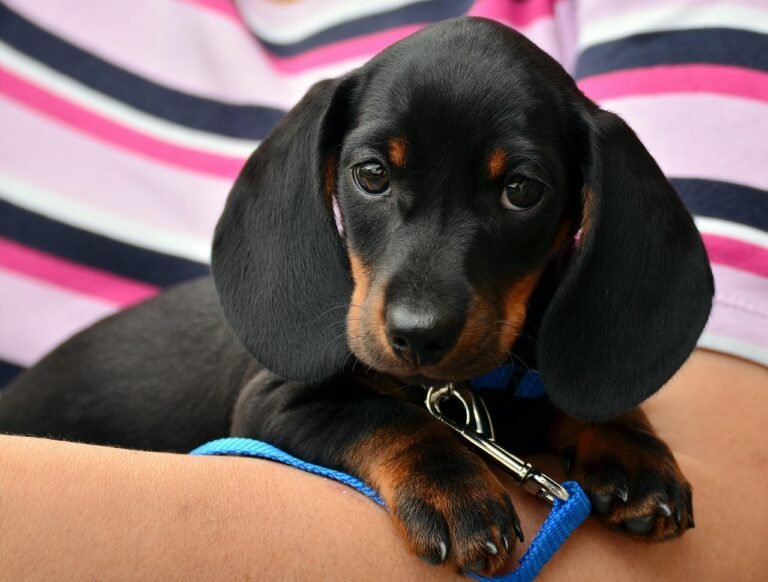
Intervertebral disc disease is common in chondrodystrophoid — short-legged, long-backed — breeds. The American College of Veterinary Surgeons notes that the Dachshund alone accounts for 45–70% of all cases, with signs in susceptible breeds typically appearing between three and six years of age.[4] Larger breeds like Labradors and German Shepherds tend to present later, usually between five and twelve.
ACVS describes the progression: back or neck pain, sometimes to the point of refusing to move around the room, then a wobbly “drunken sailor” gait, then loss of hind limb function and bladder control, and finally loss of pain perception. Disc rupture, they state, is generally considered a true surgical emergency, and the prognosis depends heavily on how quickly treatment starts and how much neurological function remains.[4]
- Wobbly, crossing or scuffing back legs, or a gait that looks drunk
- Dragging either back leg, or knuckling over onto the top of the foot
- Crying out when picked up, or a hunched, rigid posture
- Sudden inability to stand, or loss of bladder or bowel control
- Any of the above in a Dachshund, French Bulldog, Beagle, Shih Tzu, Corgi or other long-backed breed
Move a dog you suspect has a back injury as little as possible, support the whole body rather than lifting under the belly, and phone ahead.
The other explanations
Pain is the most likely answer, but it isn’t the only one, and a few of these are genuinely fixable in an afternoon.
1The floor, not the sofa
Laminate, tile and polished wood give no grip on take-off or landing. A dog whose back legs slid out from under him once will often stop attempting the jump entirely, and it reads as reluctance rather than as a surface problem. A runner or a rug in the approach path is a two-minute test, and if it works you’ve learned something real. We came at this from a different angle in our piece on dogs who suddenly avoid one room.
2Weight
Extra weight increases the load on every joint and makes existing arthritis hurt more, and it’s the one factor in this entire article you have direct control over. It’s also the intervention with the least glamour and the most evidence behind it. If you can feel his ribs easily under a thin layer, he’s about right. If you have to press, that’s the conversation to have first.
3Eyesight
Judging a jump needs depth perception. A dog with failing vision often becomes hesitant about height before anything else gives it away — stairs in dim light, the boot of the car, the edge of the sofa. If he’s also bumping into things in the evening, or startling when you approach from the side, mention it.
4One bad landing
Dogs learn from single events. A fall, a yelp, a scrabbling landing that hurt — one of those is enough to make a dog write off a piece of furniture, even after the injury itself has healed. This is a real explanation, but it’s also the one owners reach for too readily, so treat it as the conclusion after a vet check rather than instead of one.
What to do this week
- Film it. Two or three attempts, plus him getting up from lying down, plus a walk down the hallway from behind. Dogs are famously stoic in consulting rooms and this is the single most useful thing you can bring.
- Note the timing. Worse in the morning? After a long walk? Only on the wood floor? Better once he’s warmed up? Each of those points somewhere different.
- Put a runner down in the approach and landing area for a fortnight and see whether anything changes.
- Stop him having to jump for now. A ramp or a couple of pet steps, or lift him — supporting chest and hindquarters, not under the belly. This isn’t giving up; it’s not asking a sore joint to do the one movement that loads it hardest.
- Weigh him, and be honest about the number. Then ask your vet for a body condition score rather than guessing.
- Book the appointment and use the word “pain.” Say he’s stopped jumping on the sofa. Ask directly whether a trial of pain relief is appropriate — a dog who transforms on a two-week course has effectively answered the diagnostic question, and vets use exactly that approach.
- Don’t start human painkillers. Ibuprofen and paracetamol are toxic to dogs and can cause kidney failure and gastric ulceration. This is not a case of finding the right dose.
- Don’t let joint supplements substitute for a diagnosis. They may have a place in a broader plan, but reaching for a tub of green-lipped mussel for six months while an undiagnosed problem progresses is the version of this that ends badly.
Common questions
My dog won’t jump but walks completely normally. Is that still arthritis?
Very possibly. Jumping loads joints far harder than walking does, so it’s often the first thing to go while a dog still walks without a visible limp. The absence of lameness proves very little — one veterinary study concluded that screening is worthwhile even in dogs with no owner-reported lameness at all.
Isn’t my dog too young for arthritis?
Probably not. A 2024 study found radiographic osteoarthritis in nearly 40% of dogs aged between eight months and four years, and Cornell states plainly that OA can develop at any age, especially with contributing factors such as excess weight or an existing orthopaedic problem.
Should I let my dog keep jumping if he still tries?
Better to remove the need while you get it investigated. Provide a ramp or steps, or lift him with support under the chest and hindquarters. Repeatedly loading a painful joint doesn’t build it up, and a bad landing on a slippery floor can turn a manageable problem into an acute one.
When is a dog refusing to jump an emergency?
When it comes with neurological or spinal signs: wobbly or crossing back legs, dragging a foot, knuckling over, crying out when handled, a hunched posture, or loss of bladder control. Disc rupture is regarded as a true surgical emergency and the outcome depends on how fast treatment starts.
Will joint supplements fix it?
They aren’t a treatment on their own. Current veterinary practice is multimodal — weight management, controlled exercise and rehabilitation, prescription pain relief and joint support used together. Supplements can form part of that plan; they’re a poor reason to delay diagnosing what’s actually going on.
The bottom line
A dog who stops jumping on the sofa has told you something specific, and the evidence suggests most owners hear it as something vague. The signs are on published lists of early arthritis. The condition starts younger than people think. And roughly seven times in ten, the owner doesn’t spot it.
Film it, put a rug down, take the weight off the joint, and get him seen while the answer is still “manage this” rather than “manage what’s left.” If the back legs are involved at all, stop reading and phone an emergency vet.
Sources & references
- Enomoto, M. et al. Prevalence of radiographic appendicular osteoarthritis and associated clinical signs in young dogs. Scientific Reports (2024). nature.com
- American Animal Hospital Association. Canine osteoarthritis: An underdiagnosed condition, AAHA Trends. aaha.org
- Cornell University College of Veterinary Medicine, Riney Canine Health Center. Osteoarthritis. vet.cornell.edu
- American College of Veterinary Surgeons. Intervertebral Disc Disease. acvs.org
General information, not veterinary advice. Never give human painkillers to a dog, and treat any hind-limb weakness, dragging or loss of coordination as an emergency. More on reading the quiet signals dogs give in our dog care section.


One Comment
Comments are closed.