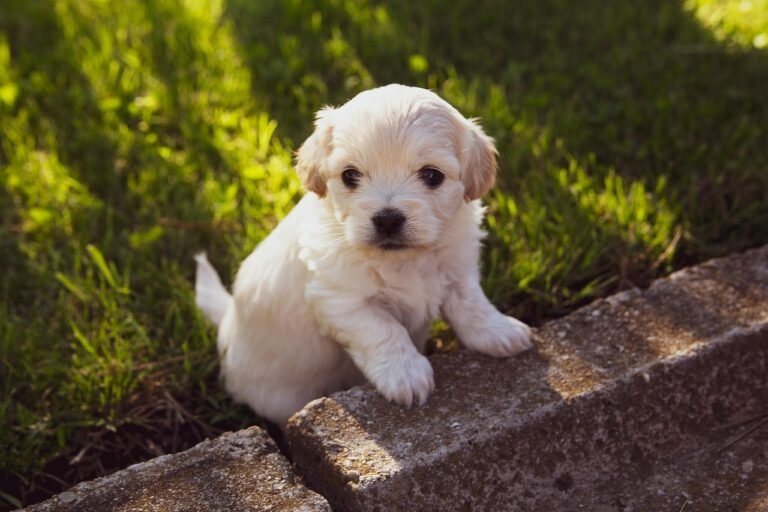
Fifteen metres from the front door, the lead goes tight. He’s sat down. Then he lies down. You say his name in the bright voice, the one that usually works, and he looks somewhere past your left shoulder as though you aren’t there.
Someone walks by and smiles. You smile back with the face of a person who has this entirely under control, and you give the lead a small tug, which achieves nothing at all.
Nearly every article about this calls it stubbornness, and nearly every one is wrong. A dog planting himself on a pavement is not being difficult. He’s doing one of four things, none of which is defiance, and the instinctive human response — pull harder — makes all four worse.
The short version
- It’s almost never stubbornness. It’s fear, pain, confusion, or a habit that’s been accidentally rewarded.
- Pulling is the worst available response. Dogs push back against pressure, and steady traction on a neck collar raises intraocular pressure.
- In puppies, freezing is usually fear. The world is loud and enormous and the pavement is ninety seconds from the front door.
- A dog who suddenly stops walking after months of walking fine is a physical question first.
- The fix is to make the walk smaller, not to make the dog braver.
What’s in this guide
It isn’t stubbornness
Stubbornness implies a dog who understands the request, is capable of it, and has decided not to. That’s a much more sophisticated thing than what’s actually happening on the pavement, and it’s worth abandoning early because it leads straight to the wrong response.
He’s frightened
Freezing is a defensive response, not a decision. Common in puppies and in newly adopted dogs. Look for a low body, tucked tail, tight mouth, and a dog who won’t take food he’d normally mug you for.
Something hurts
A joint, a paw, a back, or a harness digging in. Suspect this hard if he used to walk happily and has stopped, or if he goes willingly one direction and not another.
He doesn’t know what to do
Nobody taught him that a tight lead means “come this way.” A young puppy on his fourth ever walk has no idea what any of this means.
And then the fourth, which doesn’t fit neatly in a box because it sits on top of the other three: stopping has worked before. Every time a planted dog gets a biscuit, a fuss, a cuddle or a lift home, the behaviour gets a little more reliable. Nobody intends to train this. Everybody does it.
Offer something genuinely good — not a dry biscuit, actual chicken. A dog who takes it and eats it is nervous but coping. A dog who won’t take food he’d normally cross a room for is over threshold, and nothing you do in that moment is going to be training. Get him somewhere quieter first.
Why pulling makes it worse
Three separate problems, all triggered by the same action.
Dogs push back against pressure. Steady traction into a harness or collar tends to produce steady resistance in the opposite direction — which is why the harder you haul, the more solidly he plants. You are, without meaning to, giving him something to brace against.
It confirms the fear. If he stopped because the world felt unsafe, being dragged into it doesn’t teach him it’s safe. It teaches him that the lead is how bad things happen, and that you are attached to the lead.
And there’s a physical cost. A 2025 study in Veterinary Medicine and Science measured intraocular pressure in 20 dogs under collar and harness conditions. Neck collars raised intraocular pressure during exercise in both skull-shape groups tested, and in flat-faced dogs the collar raised it even while the dog was standing still. Back-connection harnesses did not significantly elevate it.[1]
Hauling a planted dog forwards by the neck is exactly the sustained traction that study was measuring. If your dog wears a flat collar and freezes regularly, a well-fitted harness is a sensible change on that basis alone.
Worth adding, because people reach for stronger equipment when a dog won’t move: a 2024 study in PeerJ comparing four types of walking equipment found that dogs pulled significantly more on a martingale than on the other types, and found no statistically significant difference in pulling between a prong collar and the less aversive options.[2] The harsher tool did not outperform. The authors were careful about generalising beyond their controlled setup, but the direction is clear enough: escalating the hardware isn’t buying you anything.
Fear: the usual answer in puppies
If your puppy is new to walks, start here. A pavement is a genuinely overwhelming place for an eight-to-sixteen-week-old animal who until recently lived in one room with his siblings. Lorries. Wheelie bins. A pigeon. Drain covers that feel wrong under the feet. Wind.
He isn’t refusing the walk. He’s overloaded, and freezing is what dogs do when they’re overloaded and can’t leave.
This matters more than it sounds, because the window you’re working in is short and it doesn’t come back.
Read that second sentence carefully, because it reframes the stakes. This isn’t a question of whether your puppy gets his walk today. Dragging a frightened puppy through experiences he can’t cope with, during the exact window when his opinion of the world is being formed, is how you end up with an adult dog who is afraid of the street.
The good news is that the fix for a frightened puppy is easy and slightly counterintuitive: do less. Carry him to a quiet bench and let him watch the world from your lap. Sit in your own front garden with the gate open. Walk ten metres and go home while he’s still enjoying it. None of that feels like progress. All of it is.
Pain, and badly fitted kit
There’s one version of this that should send you to a vet rather than a trainer, and it has a specific shape: a dog who used to walk perfectly well and has stopped.
Freezing, reluctance to set off, stopping earlier and earlier on the same route, or being happy to walk towards home but not away from it — those are all consistent with something hurting. Dogs are not good at telling you where. They’re quite good at declining to do the thing that hurts, which from the pavement looks like obstinacy.
This is the same logic we’ve written about elsewhere: a dog who has stopped jumping on the sofa is usually making a decision about pain rather than about furniture, and the evidence suggests owners miss early joint pain far more often than they catch it.
Then there’s the equipment, which is quick to rule out and surprisingly often the answer:
- A brand new harness. If the freezing started the week the harness arrived, that’s your suspect. Some dogs hate the feeling immediately; others dislike a strap sitting across the shoulder or rubbing in the armpit.
- Fit. You should get two fingers flat under any strap. Check the armpit area specifically — that’s where rubbing happens and where you’ll find bald patches if it’s been going on.
- Sore feet. Hot pavements in summer, grit and salt in winter, a cut pad, or something wedged between the toes. Check all four before you conclude anything behavioural.
- Harness introduced badly. A harness that only ever appears seconds before a scary walk becomes part of the scary walk. Feed him in it indoors for a few days.
When stopping has been taught
This is the uncomfortable one, and it usually coexists with the others rather than replacing them.
Dogs repeat what works. If planting himself has reliably produced treats, sympathy, a turn for home, or being carried, then it now has a function. That’s not manipulation and it isn’t naughtiness — it’s ordinary learning, and it means the behaviour will persist even after whatever originally caused it has gone.
You can usually spot it by the quality of the freeze. A frightened dog looks frightened: low, tight, scanning, not eating. A dog running a learned routine tends to look relaxed — loose body, ears up, watching you with interest, happy to take food while sitting firmly in place.
The answer is not to get sterner. It’s to stop paying for the stop and start paying generously for movement, which is the whole of the next section.
What to do instead
- Check the body and the kit first. Paws, harness fit, and a vet check if this is new behaviour in a dog who used to walk fine. Do not train your way through pain.
- Shrink the walk until he can do it. If he manages fifteen metres, the walk is fifteen metres — done four times a day, ending while he’s still happy. Success repeated is what builds this. Distance is a side effect.
- Stop pulling. Wait instead. Slack lead, turn side-on, stop staring at him, and give it thirty to sixty seconds without saying anything. A remarkable number of dogs unstick themselves once the pressure and the attention come off.
- Pay the first step. The instant he moves — one paw counts — mark it with a word and feed him. Then feed the next step. Early on you are not walking, you are teaching him that forward motion pays.
- Move away from him, don’t face him. Facing a dog and calling him blocks the direction you want. Turn your shoulders the way you’re going and take a couple of steps; most dogs follow the movement.
- Use sniffing as the reward. Let him stop and sniff a lamppost as payment for walking to it. Sniffing is genuinely enjoyable for dogs and it settles them, which makes it far more useful on a nervous walk than chicken alone.
- Pick easier routes for a few weeks. A quiet back street at 7am is a different planet from the school run. Rebuild in easy places, then add difficulty deliberately, one variable at a time.
- Dragging, or lifting him forward by the lead. It adds neck pressure, confirms the fear and teaches him to brace.
- Telling him off for stopping. A frightened dog now has the street and you to worry about.
- Buying a stronger collar. The evidence doesn’t support it, and it doesn’t address any of the four causes.
- Feeding him while he’s planted. Understandable, and it pays the exact behaviour you want to reduce. Wait for movement, then pay.
Common questions
Why does my puppy refuse to walk on the lead?
Usually fear rather than defiance. A pavement is an overwhelming place for a young puppy, and freezing is a normal response to being overloaded and unable to leave. It can also mean he simply hasn’t learned yet what lead pressure means, or that something in the kit is uncomfortable. Shorter, easier outings work better than longer ones.
My dog used to walk fine and has suddenly stopped. What changed?
Treat this as a physical question first. Sudden reluctance in a dog with a normal walking history is consistent with pain — joints, back, or feet — or with new equipment that doesn’t fit. A one-off frightening event on a specific route is the other common explanation. See a vet before working on it as a training problem.
Should I use a collar or a harness for a dog that freezes?
A well-fitted harness. A 2025 study found that neck collars raised intraocular pressure during exercise while back-connection harnesses did not, and a dog who plants himself is exactly the dog whose owner ends up applying sustained neck pressure. Check fit carefully, especially around the armpits.
Is it okay to carry my puppy on walks?
Yes, and for a frightened puppy it’s often the best available option. Carrying him to a quiet spot to watch the world is genuine socialisation without forcing him to cope on the ground. AVSAB regards the first three months as the most important socialisation window, and exposure that the puppy can handle is worth far more than distance covered.
Will he grow out of it?
Sometimes, but it’s not a safe assumption. Fear left to run tends to entrench rather than fade, and a stop that reliably earns attention becomes a habit. A few weeks of short, easy, well-paid walks usually shifts it; months of dragging usually doesn’t.
The bottom line
A dog on the floor at the end of a tight lead is telling you the walk is currently beyond him — because it frightens him, because something hurts, because nobody’s explained it, or because stopping has been working. Not one of those improves with force.
Check his body, check the harness, then make the walk small enough that he can succeed at it and pay him well for moving. It looks like going backwards for about a fortnight. It’s the fastest route there is.
Sources & references
- Bailey et al. Effect of a Collar and Harness on Intraocular Pressure and Respiration Rate of Brachycephalic and Dolichocephalic Dogs. Veterinary Medicine and Science (2025). onlinelibrary.wiley.com
- Comparing efficacy in reducing pulling and welfare impacts of four types of leash walking equipment. PeerJ (2024). peerj.com
- American Veterinary Society of Animal Behavior. Position Statement on Puppy Socialization. avsab.org
General information, not veterinary or behavioural advice for an individual dog. If your dog has suddenly stopped walking, or is freezing alongside any lameness or reluctance to be touched, see your vet first. More on settling a new dog in our guides to the first week with a new dog and the puppy witching hour, or browse the dog care section.