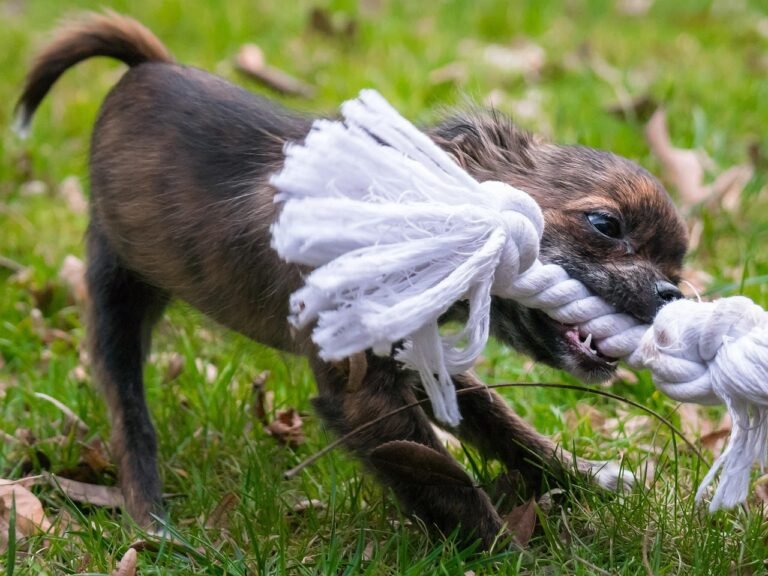
Two hundred metres in, he spins round, takes the lead in his mouth about halfway along, braces his front legs and starts shaking his head like he’s killing something. You lift the lead up out of reach and he leaps for it. You pull it away and he clamps down harder, growling in a way that makes the man at the bus stop look over.
You get home with a wet, chewed lead and a puppy who seems delighted with himself, and you spend the evening wondering whether something is seriously wrong with your dog.
Almost certainly not. What you have is a tug game, and the reason it’s so hard to stop is that you are the other player.
The short version
- Lead biting is play, frustration or anxiety — not aggression and not dominance.
- The lead is a near-perfect tug toy: long, moving, attached to a person, and it pulls back.
- Dogs Trust warns that tugging back encourages the dog to try even harder, and that chain leads and muzzles can make things worse.
- It clusters at the start of walks (over-excitement) and the end (an overtired dog with no off switch).
- The fix is a boring lead, a legal tug toy, and getting your hands off the game.
What’s in this guide
Why the lead is such a good toy
Think about what makes a toy interesting to a dog. It moves. It’s long and floppy. It’s near his face. It resists when he grabs it. It’s connected to the most interesting thing in his world, which is you.
Now describe a lead.
Nobody designed it as a tug rope, but functionally that’s what a puppy is holding. And unlike an actual tug toy, it never goes away, never gets put in a cupboard, and is present at exactly the moments when he is most excited — the start of a walk, the sight of another dog, the last hundred metres home.
The grabbing, bracing, growling and head-shaking look alarming to people because they look like fighting. They’re the standard motor patterns of play tug, which in a dog are borrowed from predatory behaviour. A growl in this context is a play growl. It’s the same sound he makes with a sock.
Play is loose, bouncy and elastic — he lets go and re-grabs, his body wiggles, he bounces around, and he’d rather have the lead than escape from you. Trouble looks different: stiff body, hard stare, a low still growl, teeth deliberately finding skin, and a dog trying to get away rather than trying to keep playing. The second picture is worth professional help; the first is just a puppy.
The three reasons dogs do it
Dogs Trust, which calls this “lead ragging,” sets out three drivers, and it’s worth working out which one you’ve got because the handling differs.[1]
Frustration
The commonest. He’s been stopped from doing something he badly wants — greeting a person, reaching another dog — and the lead is what’s stopping him. Dogs Trust names frustration at being prevented from something as a direct cause.
Boredom or attention
Dogs Trust notes that tugging the lead can be a way of starting a game with the owner or getting attention. And it works instantly, every time, which is exactly why it sticks.
Anxiety
Dogs Trust describes dogs targeting the lead because it is the reason they can’t get away from something worrying. Same behaviour, completely different emotional state, and it needs space rather than training drills.
The attention one deserves a moment’s honesty. When your puppy grabs the lead, what happens? You stop walking. You look at him. You speak to him, probably loudly. You use both hands. You make the lead move about.
From his point of view he has just pressed a button that reliably produces your complete, animated, two-handed attention. No other behaviour he has works that fast.
The fourth reason: he’s cooked
There’s a pattern that most owners spot only after they start keeping track: lead biting clusters at the two ends of the walk. The first five minutes, when he’s fizzing. And the last ten, when he’s run out of capacity.
That second one is the same overtiredness problem that produces evening chaos indoors, and the numbers behind it are striking.
If the biting reliably starts twenty-five minutes into a thirty-minute walk, the honest answer may be that your walk is five minutes too long. Shortening it is not a defeat. It’s the single easiest change on this page, and for a fair number of puppies it’s most of the fix. We’ve written about the indoor version of the same problem in the puppy witching hour.
What you’re doing, and what he’s learning
Every instinctive response to a dog grabbing the lead makes the game better. Here’s the translation.
| What you do | What he learns | Do this instead |
|---|---|---|
| Pull the lead back | Tug is on. Dogs Trust warns this “could encourage them to try even harder to grab the lead.”[1] | Go still. Hands close to your body, no tension. |
| Lift it over your head | Brilliant — the toy now flies. Jumping added to the game. | Drop your hand low and stop the movement. |
| Shout his name | Noise and attention, delivered instantly. | Say nothing at all for ten seconds. |
| Push him away | Physical contact, which for most puppies is more play. | Step on the lead near the clip so it goes dead. |
| Offer a treat to swap | Grabbing the lead produces food. Repeat tomorrow. | Wait for him to let go, then pay the calm. |
| Buy a chain lead | Dogs Trust cautions that chain leads and muzzles “might actually make things much worse.”[1] | Change what happens, not the hardware. |
Swipe the table sideways to see all columns.
The treat swap is the one that catches out careful owners, because it feels like positive training. The problem is timing: if food arrives while the lead is in his mouth, you’ve paid for the grab. Wait the extra two seconds for him to let go, then pay.
The fix, step by step
The principle is simple. Make the lead boring, make something else fun, and stop being the second player.
- Carry a real tug toy. A long rope or a fleece tug on your belt. He needs somewhere legal to put that urge, and telling a puppy not to tug is like telling him not to sniff. Dogs Trust suggests offering toys to redirect attention away from the lead.[1]
- Get in first. Don’t wait for the grab. If he always starts at the corner by the postbox, produce the toy before the postbox. You’re aiming to replace the habit, not to interrupt it.
- Kill the movement. When he does grab it, stand still, drop your hands to your waist, look at the horizon and say nothing. A lead that doesn’t move isn’t a toy. Ten seconds of complete boredom ends more of these than any command.
- Stand on the lead. If he’s genuinely hanging off it, step on it close to the clip so there’s no slack to pull. Now it’s a dead rope attached to the pavement, and there’s nobody to play with.
- Pay the moment he lets go. Mark it and feed, or better, start walking — for most puppies, moving forward is the reward they actually wanted.
- Scatter feed. Throw a handful of kibble into the grass. It puts his nose down, and sniffing genuinely settles dogs in a way that another minute of walking doesn’t.
- End the walk early for a fortnight. If the biting starts at twenty-five minutes, walk twenty. Build back up once you’ve had a week of clean walks. You’re banking successes rather than testing the limit.
Keep the sessions boringly consistent. The behaviour has usually been rehearsed dozens of times, so it takes more than one good walk to shift — but most people see a real difference inside a couple of weeks.
Equipment that helps, and kit that doesn’t
Hardware won’t solve this, but a few things make the training easier, and a couple make it harder.
- A longer lead helps more than a shorter one. Two metres gives him room to move without constant tension, and tension is what starts the game. Short leads keep the rope right beside his mouth.
- A well-fitted harness reduces the sudden jolts that trigger grabbing, and avoids sustained pressure on the neck when he does hang off the lead.
- Two leads clipped on is a useful trick for determined grabbers — when he takes one, quietly let go of it and hold the other. There’s nothing to pull against, and the game ends by itself.
- Chain leads and muzzles are not the answer. Dogs Trust says directly that these might make things much worse, and risk making a dog even more anxious, frustrated or agitated.[1] A chain lead also damages teeth.
- Bitter sprays may stop the chewing without touching the frustration or over-arousal underneath. Sometimes useful alongside training; never a plan on its own.
Grabbing the muzzle, pinning, scruffing or smacking are all poor responses here. The ASPCA is explicit that slapping or hitting puppies for playful mouthing can cause them to bite harder, and recommends redirection and brief time-outs instead.[3] The AVSAB’s position statements favour reward-based methods over aversive ones.[4]
There’s also a practical problem: an over-aroused puppy reads rough handling as the game getting better. You’ve just tugged back with your hands.
When it isn’t a game
Two versions of this need a different response.
The anxious version. If he grabs the lead specifically when a dog or a person approaches, and the rest of him looks worried rather than delighted, the lead isn’t a toy — it’s the thing preventing escape. Drills won’t help. More distance will. This is worth getting a qualified behaviourist involved in early rather than late.
The sudden version. A dog who has walked calmly for months and abruptly starts grabbing the lead has changed for a reason. New equipment is the first suspect — check harness fit around the armpits. After that, consider discomfort: the same logic we’ve applied to dogs who plant themselves and refuse to walk applies here, because pain and irritation both show up as behaviour long before they show up as limping.
Common questions
Why does my puppy bite the lead on walks?
Usually because it works as a tug toy. Dogs Trust identifies frustration at being stopped from something, boredom or seeking attention, and anxiety about something nearby as the three main drivers. It’s play behaviour or emotional overflow, not aggression or dominance.
Is my puppy being aggressive when he growls and shakes the lead?
Almost never. Grabbing, bracing, head-shaking and growling are normal tug play in dogs. Look at the whole body: loose, bouncy and elastic means play. Stiff, still, hard-eyed, with teeth deliberately seeking skin, is different and worth professional advice.
Should I just let go of the lead when he grabs it?
Not in a public place, for obvious safety reasons. A better version is to step on the lead near the clip so there’s no slack to pull against, or to walk two leads and quietly release the one he’s taken. Either way the aim is the same — remove the resistance that makes it a game.
Will a chain lead stop my dog biting the lead?
Dogs Trust advises against it, warning that chain leads and muzzles may make things much worse and increase anxiety, frustration or agitation. A chain can also damage teeth. Changing what happens when he grabs is more effective than changing what he’s grabbing.
When will my puppy grow out of biting the lead?
Many dogs settle through adolescence as impulse control develops, but it doesn’t reliably fade on its own — especially if grabbing has been paid with attention for months. Most owners see a clear improvement within two to three weeks of shorter walks, a legal tug toy and going still instead of pulling back.
The bottom line
Your puppy isn’t challenging you. He’s holding the most appealing toy available, at the moment he’s least able to make good decisions, and the person on the other end keeps playing.
Bring a proper tug toy and use it before the grab rather than after. Go completely still when it happens. Pay him for letting go, not for holding on. And if it always kicks off near the end of the walk, make the walk shorter — that one change fixes more of these than anything else on this page.
Sources & references
- Dogs Trust. Lead ragging. dogstrust.org.uk
- American Kennel Club. How to Make Sure Your Puppy Gets Enough Sleep. akc.org
- ASPCA. Mouthing, Nipping and Biting in Puppies. aspca.org
- American Veterinary Society of Animal Behavior. Position Statements. avsab.org
General information, not behavioural advice for an individual dog. If your dog’s lead biting comes with stiffness, hard staring or teeth deliberately meeting skin, or if it started suddenly in a dog who previously walked calmly, speak to your vet or a qualified behaviourist. More in our guides to the first week with a new dog and the dog care section.