
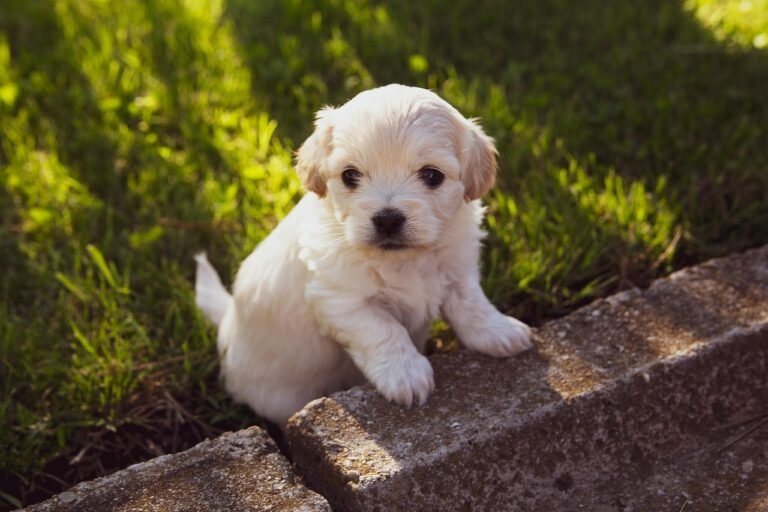
Somewhere between six and eight in the evening, the puppy you’ve had all day gets replaced. This one grabs trouser legs. Bites harder when you tell him off. Races the length of the hall with his back end tucked under him, ignores his name entirely, and gets his teeth into your wrist hard enough that you say something you wouldn’t repeat.
Twenty minutes later he’s unconscious on the rug and you’re sitting there wondering what you’ve done.
Everyone calls this the witching hour. Most of the advice you’ll find treats it as an energy problem — he’s got too much in the tank, so burn it off. That advice is the single most reliable way to make tonight worse, because in the great majority of cases this is not a puppy with too much energy. It’s a puppy who is exhausted and has no idea how to stop.
The short version
- Evening mayhem in a puppy is usually overtiredness, not excess energy. It looks identical from the outside and needs the opposite response.
- Puppies sleep 18–20 hours a day. Most puppies having a nightly meltdown are nowhere near that.
- More walking, more play or more training in the evening adds fuel. So does a house full of people at 6pm.
- The fix is a nap before the crash, not a plan for after it.
- Once he’s over the edge, the evidence-based move is a short time-out, not a telling-off. Physical punishment makes puppies bite harder.
What’s in this guide
What’s actually happening
Anyone who has been near a toddler at bedtime already knows this pattern. Past a certain point, tiredness stops looking like tiredness. It looks like acceleration — faster, louder, less able to hear you, less able to stop.
Puppies are worse at this than almost any other animal you’ll live with, because their sleep requirement is enormous and their off switch is undeveloped.
Sit with that number for a second, because it reframes everything. Twenty hours asleep leaves four hours awake across an entire day. A puppy who is up for six or seven hours — which is completely normal in a busy household, and which no one is doing deliberately — is carrying a sleep debt by teatime.
And sleep debt in a young animal doesn’t present as yawning. It presents as a puppy who cannot regulate himself, whose behaviour gets rougher rather than softer, and who genuinely cannot respond to a cue he knew perfectly well at lunchtime.
Watch what happens straight after the meltdown. If he collapses into a hard sleep within half an hour of it ending — properly out, not dozing — he was tired, not under-exercised. A genuinely under-stimulated dog doesn’t crash like that. He stays restless.
Why the usual advice backfires
The standard prescription is a longer walk, a game of fetch, or a training session to tire him out mentally. Each of those is good advice at the wrong time of day.
Everything on that list is stimulation, and a tired puppy’s problem is that he has had too much of it and hasn’t slept it off. Adding more at 6pm is like handing an overtired child a fizzy drink and asking them to calm down. You will get compliance for about eleven minutes and then a worse version of the same thing.
There’s a second problem specific to evenings, and it has nothing to do with the puppy. Six o’clock is when the household changes state: people come home, the kitchen gets busy, children arrive, the television goes on, someone’s making dinner, everyone wants to say hello to the puppy. From his point of view the environment has just become far more interesting at precisely the moment he had least capacity left to cope with it.
So the witching hour usually isn’t caused by the puppy at all. It’s caused by the collision between a sleep-deprived animal and the busiest hour in the house.
The arithmetic of a puppy’s day
Most owners are genuinely surprised when they count it up. Try this honestly for one day — not the day you plan to have, the day you actually have.
| What counts as awake time | Why it counts |
|---|---|
| Walks and garden time | Obvious, and usually the only thing people count. |
| Play, tug, fetch, chew sessions | Arousing rather than restful, even when he’s lying down for it. |
| Training, however short | Cognitively demanding. Five minutes of training is not five minutes of rest. |
| Being handled, groomed, cuddled, photographed | Counts as awake, and for many puppies counts as stimulating. |
| Visitors, children, the doorbell, deliveries | High arousal even if he never leaves his bed. |
| Lying in the middle of a busy room, eyes open | This is the big one. Being present in the household is not sleep, and a puppy in the kitchen at dinner time is working, not resting. |
Swipe the table sideways to see all columns.
That last row is where most households lose four hours a day without noticing. The puppy is quiet, he’s not demanding anything, so it reads as downtime. It isn’t. Dozing in a room where things keep happening is qualitatively different from sleeping somewhere dull.
The routine that prevents it
Prevention is nearly all of the solution here, and it is much easier than managing the aftermath. The principle is simple: get the nap in before the crash, not after it.
- Work out when it starts. Note the time for three or four days. Most households find it’s remarkably consistent — 6:15 every evening, give or take ten minutes.
- Put him down 60 to 90 minutes before that. Not when he seems tired; he won’t seem tired, that’s the entire problem. This is a scheduled nap, decided by the clock rather than by the puppy.
- Make the nap place genuinely boring. A crate or pen in a quiet room, door shut, curtains drawn if it helps, away from the kitchen. Somewhere he can’t see people moving about.
- Give him something to settle with, not something to play with. A stuffed Kong or an appropriate long-lasting chew helps a puppy come down; a squeaky toy or a tug rope does the opposite.
- Expect protest the first few nights. A puppy who has never been asked to switch off will complain about being asked to. Assuming his needs are met and he’s just been out, this settles within a few days.
- Cap the evening. After the nap, keep the last hour low-key. Sniffing in the garden, a scatter of kibble in the grass, a chew. Save fetch and wrestling for the morning.
Scatter feeding deserves a special mention, because it’s the most underrated thing on this list. Throwing a handful of his dinner into the lawn or a snuffle mat gives him ten or fifteen minutes of nose work, and sniffing is one of the few activities that genuinely settles dogs rather than winding them up. It’s the closest thing there is to a calm-down button.
What to do once he’s gone
Prevention fails sometimes. When he’s already latched onto your sleeve and escalating, the goal changes: end it cleanly, take nothing personally, and get him asleep.
The ASPCA’s guidance on puppy mouthing is worth following closely here, because it’s specific about what works. Puppies normally learn bite inhibition through play with littermates — one bites too hard, the other yelps and stops playing — and people can use a version of the same feedback.[2]
- Stop moving. Hands still, no jerking away. The ASPCA specifically cautions against waving hands and making jerky movements, which make you a better toy.[2]
- Substitute a toy when he goes for fingers or toes — one of the ASPCA’s core recommendations, and the one that costs you nothing to try first.[2]
- Use a time-out. The ASPCA describes time-outs as often very effective for curbing mouthing in puppies: withdraw attention for something in the region of ten to sixty seconds.[2] Leaving the room yourself is usually cleaner than carrying a biting puppy anywhere.
- Then put him to bed. This is the step people skip. A time-out ends the incident; it doesn’t fix the sleep debt that produced it. Once he’s off you, he goes into the pen and the evening is over for him.
The ASPCA is direct about it: slapping or hitting puppies for playful mouthing can cause them to bite harder.[2] The same goes for holding the mouth shut, pinning, scruffing or alpha rolling.
The American Veterinary Society of Animal Behavior’s position statements favour reward-based methods and warn against aversive techniques for exactly this reason.[3] Beyond the welfare argument, there’s a practical one: an over-aroused puppy reads rough handling as the game escalating, so you have just joined in.
When it isn’t the witching hour
The pattern above is specific: predictable time of day, short-lived, followed by hard sleep, and gone within a few weeks of getting the naps right. When it doesn’t fit that shape, look again.
It’s all day
Constant mouthing at every hour, not an evening spike, may mean unmet basic needs — not enough sleep at all, hunger, or nowhere appropriate to chew. Worth a rethink of the whole routine.
He can’t settle at all
A puppy who never switches off even in a quiet dark room, or who is frantic rather than boisterous, is a different conversation. Get a vet to rule out discomfort first.
It doesn’t look like play
Stiff body, hard stare, growl that doesn’t sound playful, freezing over food or a toy, or biting that draws blood repeatedly. Get professional help early rather than late.
That middle one matters more than it sounds. Behaviour that arrives suddenly, or that doesn’t respond to a reasonable change in routine, is worth a physical check before it’s treated as a training issue — a principle we’ve written about in the context of dogs who suddenly avoid one room of the house.
And if your puppy is very new, remember that the first fortnight has its own rules. Our guide to the first week with a new dog covers the settling-in period, which overlaps with all of this.
Common questions
What time is the puppy witching hour?
Most households report it between about 5pm and 9pm, and for any individual puppy it tends to be strikingly consistent — often within ten or fifteen minutes of the same time each evening. That predictability is useful: it lets you schedule a nap 60 to 90 minutes beforehand.
Should I walk my puppy more to tire him out?
Not in the evening, and probably not more overall. Walking is stimulation, and evening mayhem is usually caused by too much stimulation without enough sleep rather than too little exercise. Over-exercising young puppies also carries its own risks for developing joints — worth discussing amounts with your vet.
How much should a puppy actually sleep?
The AKC puts it at 18 to 20 hours a day. Most owners are surprised when they add up their puppy’s real awake time, because quiet presence in a busy room reads as rest but isn’t.
Is my puppy being aggressive when he bites in the evening?
Almost never. Mouthing and play biting are normal puppy behaviour and are how bite inhibition develops. Stiff posture, hard staring, guarding food or toys, or repeated bites that break skin are a different picture and worth getting professional help with promptly.
When does the witching hour stop?
With consistent enforced naps, most owners see a marked improvement within one to two weeks — often before the puppy is any older, which tells you it was the routine rather than the age. Play biting generally reduces through adolescence as bite inhibition and impulse control develop.
The bottom line
You are not failing, and he is not being difficult. You have a young animal with a very large sleep requirement, a small tolerance for stimulation, and no ability yet to recognise that he needs to stop.
Note the time it starts. Put him to bed ninety minutes before it. Keep the last hour of the evening dull. If he goes over anyway, take the attention away for a minute and then end his day. Most people see this improve in a fortnight, which is a short time to be biting your sleeves, even if it doesn’t feel that way tonight.
Sources & references
General information, not veterinary or behavioural advice for an individual dog. If your puppy’s biting is escalating, breaking skin, or accompanied by stiffness, growling or guarding, speak to your vet or a qualified behaviourist rather than waiting it out. More in our dog care section.


One Comment
Comments are closed.