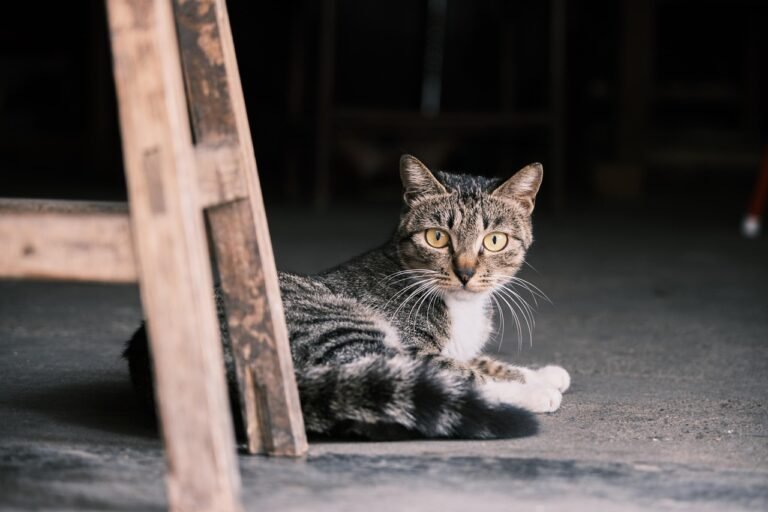
The scratching post cost about £40. It got used twice, on the day it arrived, with the kind of enthusiasm that makes you think the problem is solved. Since then it has stood in the corner of the spare room doing nothing, while the cat works the front left corner of the sofa every morning at roughly half six.
This is the single most common complaint I hear about cats, and almost every piece of advice written about it starts from the wrong place. It treats the post as the correct object and the sofa as the mistake. From the cat’s point of view it is the other way round. The sofa is an excellent scratching surface. The post is a poor one. Your job is not to persuade her out of a bad habit — it is to work out which specifications the sofa is meeting that the post is not, and then meet them somewhere you don’t mind.
The short version
- Scratching isn’t a behaviour problem. It’s maintenance, stretching, and scent-marking all at once, and it cannot be switched off — only moved.
- A sofa arm passes four tests most cheap posts fail: it’s tall enough for a full stretch, completely rigid, coarse enough to catch a claw, and in the room the cat actually lives in.
- Location is the one factor with real research behind it. A 1,211-cat study found posts placed where the cat already spends time were significantly more effective.
- The same study found something counter-intuitive: more play time was linked to more scratching, not less — likely because long, over-arousing play sessions leave a cat wound up rather than settled.
- Declawing is not a solution. It’s amputation of the last bone in each toe, and the American Animal Hospital Association strongly opposes it.
On this page
What scratching is actually for
Four things happen at once when a cat drags her claws down something. She’s shedding the dead outer sheath from each claw, the way you’d peel a layer off. She’s stretching — a full-body extension from toes to shoulder that a cat can’t really get any other way. She’s leaving scent, from glands in the paw pads, which is why the marks cluster in doorways and beside favourite sleeping spots rather than in tucked-away corners. And, according to Humane World for Animals, she’s expressing emotion — excitement, frustration, anticipation. That’s why the sofa gets it hardest at the moment you come downstairs, or when the food cupboard opens.
None of those four are optional. This matters because it sets the ceiling on what you can realistically achieve. A cat who has stopped scratching entirely is usually a cat who is unwell, in pain, or very old — not a cat who has learned manners.
The four specs your sofa passes and the post probably doesn’t
Pull the sofa arm and the post side by side and the differences are obvious once you’re looking for them.
| What the cat needs | Sofa arm | Typical budget post |
|---|---|---|
| Height for a full stretch | Front paws well above shoulder height, back fully extended | Often 18–24 inches — a half-stretch at best |
| Rigidity | Doesn’t move at all, whatever force she puts through it | Wobbles or tips on a light base; one wobble and she’s done with it |
| Texture that catches | Woven fabric that grips the claw and pulls back | Soft carpet remnant — too yielding to give resistance |
| In the right room | The centre of family life, by the door, next to where she sleeps | Spare room, hallway, behind an armchair |
Humane World’s specification is worth quoting because it’s unusually precise: a post should be at least 32 inches tall, will not wobble when scratched, and made of a type of rope called sisal. Thirty-two inches is taller than a lot of what’s sold in supermarkets. The American Animal Hospital Association puts the same idea differently — posts should be tall or long enough for a full stretch, and firmly anchored.
Rigidity is the one people underestimate. A cat leans her whole weight into a scratch. If the base shifts even slightly the first time, that surface is quietly filed as unreliable and she goes back to the thing that doesn’t move. This is also why bolting a post to the wall, or buying one with a base plate wide enough to stand on, changes outcomes more than upgrading the material does.
And some cats aren’t vertical scratchers at all. If the damage on your sofa is on the flat seat cushion rather than the arm, a tall post was never going to be the answer — you want a horizontal cardboard or sisal pad instead. Humane World notes wood is ideal for cats who prefer horizontal surfaces.
Why location beats everything else
Most advice about posts is opinion. There is one factor with decent evidence behind it, and it’s the one people ignore because it’s inconvenient.
A 2024 study in Frontiers in Veterinary Science surveyed the owners of 1,211 cats about scratching behaviour and the household conditions around it. The finding on placement was direct: the location of scratching posts emerged as a significant factor, with posts placed in areas frequented by the cat being more effective.
So the post does not go where it looks least offensive. It goes directly beside the bit of sofa she is already using. Humane World says the same thing in plain terms: if your cat enjoys scratching the couch, place the scratching post next to the couch. It will look bad in your living room for a few weeks. That is the trade.
Once she’s using it reliably — think a month, not a week — you can shift it a few inches at a time. If she goes back to the sofa, you moved it too far or too fast. Move it back.
The play finding that flips the usual advice
Here’s the part of that study that surprised me. The standard advice for any unwanted cat behaviour is play with her more. The data pointed the other way. The researchers reported that the duration of play, playfulness, and nocturnal activity were identified as significant contributors to heightened scratching levels.
More play time went with more scratching, not less. The authors’ own interpretation is that prolonged or inappropriate play routines may leave a cat over-aroused rather than satisfied — increased stress and irritability instead of a settled animal. It fits what cats do naturally: short bursts, a catch, then rest. A thirty-minute laser session with no capture at the end isn’t a longer version of that. It’s a cat who never got to finish.
The same study found scratching intensity was significantly related to reported disruptiveness in the home, and that the presence of a child may be associated with higher levels. Household tension is not a separate topic from scratching. It’s part of the same picture — which is why a cat who starts shredding after a house move, a new baby, or a new cat is telling you something about stress rather than about furniture.
Stress shows up in other ways alongside it. If she’s also overgrooming, that can change how much fur she swallows — worth reading our guide to how often hairballs are actually normal in cats if the two have appeared together.
What to change this week
- Look at the damage and work out the angle. Vertical marks on the arm means she wants height. Horizontal shredding on the seat means she wants a flat pad. Buy for the angle you actually see, not the one you assumed.
- Get something at least 32 inches tall, sisal-wrapped, on a base you could stand on. Push it hard with one hand in the shop or after unboxing. If it rocks, return it.
- Put it right against the damaged corner. Touching it. Not across the room, not tucked behind the sofa.
- Make the sofa corner worse. Double-sided tape or a smooth plastic guard over that spot for a few weeks, so the new post is the easier of two options sitting side by side.
- Pay her for using it. Catnip on the post, and a treat the moment she uses it — not thirty seconds later.
- Keep the claws trimmed. Every couple of weeks, just the sharp tip. It doesn’t stop scratching but it reduces what a scratch does to fabric.
- Only then start moving it, a few inches at a time, once she’s used it daily for a month.
One thing worth checking before you blame the post: can she still physically do it? A cat who used to stretch up tall and now scratches low, or has stopped using a cat tree, may be sore rather than fussy. We wrote about that pattern in what it means when a cat stops jumping on the counter — the same joint changes that shorten a jump also shorten a stretch.
A word on declawing
Three to seven times. The procedure trades a damaged sofa for a cat who may bite instead, because her first line of defence has been removed, and who may stop using the litter tray because digging in grit hurts. It is banned or restricted across much of Europe and in a number of US states. Claw caps, trimming, and a post that actually meets the specification above are the alternatives, and they work when you get the placement right.
Common questions
How long before she switches to the post?
Days for some cats, several weeks for others. If nothing has changed after a month with the post touching the damaged corner, the problem is usually the post itself — height or stability — rather than her willingness.
Will more posts help?
Often yes, especially in a multi-cat house, because scratching is partly scent-marking and cats mark separately. One by the sofa, one by the bedroom door, one near where she sleeps is a reasonable starting layout.
Do sprays and deterrents work?
Deterrents on the sofa help only when there’s a genuinely better option inches away. Used alone they tend to move the scratching to a different piece of furniture rather than stopping it.
She’s scratching far more than she used to. Should I worry?
A sudden increase usually tracks a change in the household — a move, a new pet or person, building work. The 2024 research links higher scratching to stress-related factors, so look at what changed in the weeks before rather than at the furniture.
Is carpet on a post a bad material?
It’s not harmful, but it’s often too soft to give the resistance a cat wants, and it teaches her that carpet is a scratching surface — which is awkward if you have carpeted stairs. Sisal rope avoids both problems.
The bottom line
The sofa isn’t winning because your cat is stubborn. It’s winning on height, rigidity, texture and location, and it will keep winning until something else beats it on all four in the room she actually lives in. Put a tall, solid, sisal post hard against the corner she already uses, keep play short and finished, and accept that your living room looks slightly worse for a month or two.
Sources
- Salgirli Demirbas Y, et al. Frontiers in Veterinary Science, 2024 — survey of 1,211 cats on factors associated with scratching behaviour.
- Humane World for Animals — guidance on destructive scratching, post specification and placement.
- American Animal Hospital Association — position statement on declawing.