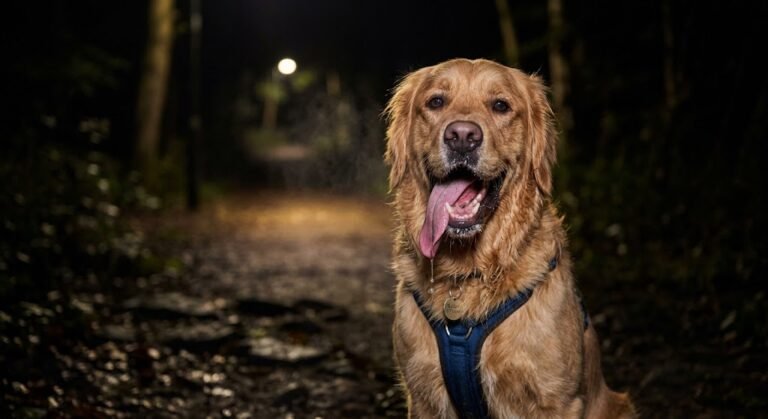
In the kitchen he is a model dog. Sit, down, wait at the door, leave the cat’s bowl alone. Take the same dog to the park and shout his name and he becomes a slightly deaf stranger who has never met you. Most people read this as defiance, or as proof that the training “didn’t take”. Neither is right, and there’s a piece of research that makes the real explanation uncomfortably clear.
In a Newcastle University study, adolescent dogs took longer to respond to a sit cue — but only when the person giving it was their own owner. Asked by a stranger, the same dogs got better over the same period. That finding reframes the whole problem. The issue usually isn’t that your dog doesn’t know the word. It’s what the word means where you are, and who is saying it.
The short version
- Dogs don’t generalise. A cue learned in the kitchen is, to the dog, a kitchen cue. Outdoors is a different picture entirely.
- Recall problems peak in adolescence. In a UK cohort of young dogs, reported recall issues rose from 3.3% at six months to 6.6% at twelve, then fell to 2.8% by eighteen months.
- Adolescent dogs specifically ignore their own person — the same dogs responded better to a stranger over the same months.
- Outdoors, the reward you’re offering has to beat the environment. Praise beats nothing. It does not beat a squirrel.
- Punishing a dog who comes back late is the fastest way to make recall worse, and aversive methods carry measurable welfare costs.
On this page
Why it isn’t defiance
Dogs are terrible generalisers. This is the single most useful thing to understand about training them. When you taught “sit” in the kitchen, the dog didn’t learn an abstract concept. He learned: this sound, from this person standing in this spot, with the fridge humming and a treat pouch in her pocket, means put my bottom down. Change the room and half of that picture disappears. Change it to a field with wind, other dogs, rabbit scent and a hundred yards between you, and almost none of the original picture is left.
So a dog who sits perfectly at home and blanks you in the park is not being selective. He is in a situation he was never actually trained for. The word is the smallest part of what he learned.
The adolescent window
There’s a second thing going on, and it has a timetable. A UK and Ireland longitudinal study following puppies through their first year and a half — surveys at 6, 9, 12, 15 and 18 months, with 1,718 responses at the first point — tracked how often owners reported recall problems.
Recall issues were reported significantly less often at six and eighteen months than at nine, twelve and fifteen. That is a hump, not a slope. If your dog is somewhere in that middle window and has suddenly stopped listening in the park, you are not watching your training fall apart. You are watching a developmental stage that a lot of dogs come out the other side of.
The Newcastle work, published in Biology Letters by Lucy Asher and colleagues, adds the sharp detail. Working with 69 dogs and then a larger group of 285 Labradors, Golden Retrievers and German Shepherds, they found the odds of repeatedly not responding to a sit cue from the caregiver were higher at eight months than at five — while responses to a stranger improved over the same period. It is specific to you. Which is oddly reassuring, and also explains why the trainer at class can get a response you can’t.
The economics of coming back
Strip the sentiment out and recall is a transaction. Your dog is choosing between what’s in front of him — a scent trail, another dog, the bin behind the café — and whatever you’re offering. Indoors, you’re competing with an empty room, so a “good boy” wins easily. Outdoors, you’re competing with the most interesting thing available, and praise loses almost every time.
This is why the same dog seems to have two different levels of training. He doesn’t. The offer changed.
| Situation | What he’s giving up | What actually beats it |
|---|---|---|
| Kitchen, no distractions | Nothing | Praise, a bit of kibble |
| Garden, familiar smells | Mild sniffing | Ordinary treats, a quick game |
| Quiet park, no other dogs | Open space, new scent | Cheese, chicken, liver — something he never gets at home |
| Park with dogs, or a scent trail | The best thing in his day | High-value food and being released straight back to it |
The last row is the one people miss. If coming back always ends the walk, you have taught your dog that his name is the sound the fun stops at. Call him, pay him, and then send him off again — most of the time. The recall that ends the walk should be a small minority of the recalls you do.
How most people poison their own recall
Three habits do more damage than any gap in training, and all three are completely understandable.
Calling when you know he won’t come. Every time the name goes out and nothing happens, the name gets slightly weaker. After a few weeks of that it’s background noise. If you aren’t reasonably confident he’ll respond, go and get him instead — don’t spend the cue.
Telling him off when he arrives. He took four minutes, you’re annoyed, and it comes out in your voice. From his side, the sequence is: came back → owner unhappy. Dogs are very good at learning that sequence. The rule is absolute — however long it took, the arrival is always a good outcome.
Using the name for everything. If his name means nail trims, baths and being shut in the kitchen as well as chicken, it’s an ambiguous signal. Plenty of trainers keep a separate, protected recall word that has never once been followed by something the dog disliked.
Rebuilding it, properly
- Pick a fresh word. If the old one is worn out, don’t try to rehabilitate it. Choose something you’d never say casually, and use it only for this.
- Start indoors, at two feet. Say the word, put food in his mouth. Twenty repetitions over a couple of days, no distance, no distraction. You’re building the association, not testing it.
- Change one variable at a time. A different room. Then you sitting down. Then the garden. Then the garden with a toy out. If a step fails, the previous step wasn’t solid — go back one, don’t push through.
- Use a long line outdoors. Ten to fifteen metres, attached to a harness rather than a collar. It isn’t a tool for reeling him in; it’s insurance so he never gets to practise ignoring you.
- Pay properly, every single time, for months. Real food, not a pat. The dog decides what counts as good pay, not you.
- Release him again. Reward, then “off you go”. This is what stops recall becoming the end of the walk.
- Only drop the line when he’s succeeding around real distractions. Not when you feel ready — when he’s come back from another dog, on the line, several times over.
Expect this to take a season, not a fortnight, and expect it to go backwards on windy days and near deer. That’s normal. Adolescence in particular is a phase you train through rather than out of — the same way the puppy witching hour is a stage rather than a fault.
And if the problem is specifically that he won’t move rather than won’t return, that’s a different issue with different causes — we covered it in why a puppy plants himself and won’t walk on the lead.
Why shock and “corrections” backfire
At the point where a dog is running off, people start looking at e-collars and prong collars. It’s worth knowing what the evidence says before you do.
Set aside the welfare argument for a moment and look at the mechanics. A dog punished at a distance often can’t tell what the punishment was for. If it lands as he turns back towards you, you have just punished the return. That is a hard thing to undo, and it is the most common way an electronic collar makes recall permanently worse rather than better.
Common questions
He comes back at home and in the garden but never in the park. Why?
Because the garden and the park are different pictures to him, and the park has competition the garden doesn’t. That’s a normal generalisation gap, not a failure. Bridge it with a long line and much better food in the harder location.
How long should a long line be?
Ten to fifteen metres for open-space work. Attach it to a harness, never a collar — a dog hitting the end of a long line at speed on a collar can injure his neck. Let it trail; don’t hold it taut.
My dog is two and still ignores me outside. Has the window closed?
No. The adolescent research explains why the problem often appears between nine and fifteen months, not why it can’t be fixed later. Adult dogs relearn recall well, they just have a longer history of ignoring the old cue — which is the argument for a fresh word.
Should I stop calling him altogether while I retrain?
Stop using the old word in situations where you know it will fail. Go and collect him instead. Build the new word separately, and only start using it outdoors once it’s rock solid at home.
Do whistles work better than a voice?
Often, yes — a whistle sounds the same whether you’re calm or furious, and it carries further. The dog still has to be taught what it means, though. The whistle isn’t magic; it’s just a more consistent signal than a human voice.
The bottom line
Your dog isn’t ignoring you outside because he’s stubborn or badly trained. He’s in an environment the training never covered, at an age when the research says he’s specifically least responsive to you, weighing your offer against the best thing in his day. Fix the environment gap with a long line, fix the offer with real food, stop spending a cue you can’t back up, and give it a season.
Sources
- Asher L, et al. Biology Letters, 2020 — adolescent-phase conflict behaviour in dogs; reduced responsiveness to the caregiver but not to a stranger.
- Generation Pup cohort, Owner-Perceived Undesirable Behaviours in Young Dogs and Changes with Age, 2025 — recall-issue prevalence at 6 to 18 months.
- Vieira de Castro AC, et al. PLOS ONE, 2020 — welfare outcomes of aversive-based versus reward-based training in 92 companion dogs.