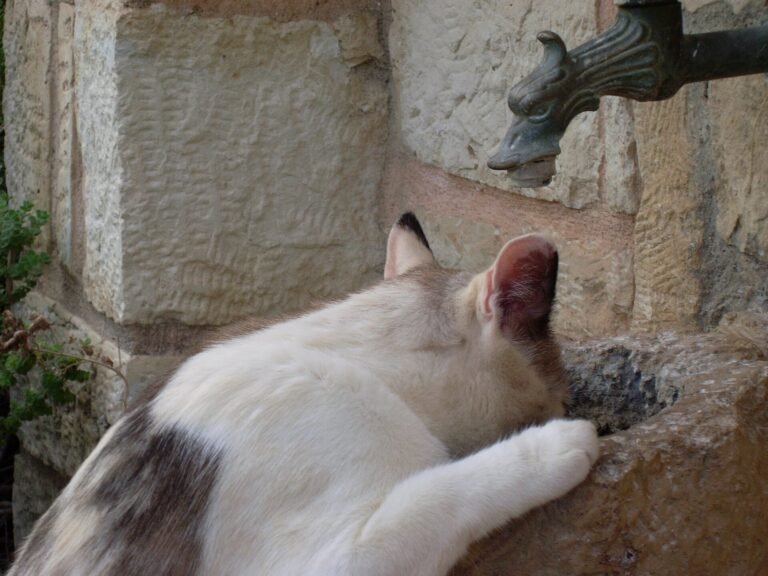
She’s parked at the water bowl again. Sitting square in front of it, head low, staring into the water like she’s waiting for something to happen. She doesn’t drink. You tip it out, rinse it, refill it with fresh water. She comes back and sits there again.
If you search this, you’ll mostly be told your cat doesn’t like the bowl. Wrong shape, wrong material, wrong position, whisker fatigue. Buy this fountain, buy this wide ceramic dish. Notice who is publishing most of those pages.
Some of that is fair enough — cats really are particular about water. But a cat who goes to the bowl and then doesn’t drink is doing something more specific than being fussy, and in an adult cat it belongs on a much shorter list than the internet suggests. The behaviour is worth taking seriously precisely because cats are so good at hiding illness that a small odd habit is often the only thing on offer.
The short version
- Wanting water but not drinking is more often nausea than preference. Nausea makes swallowing unappealing while thirst stays switched on.
- In a cat over about seven, the first thing to rule out is kidney disease — it affects up to 40% of cats over 10.
- Mouth pain does the same thing: the cat wants the water, the water hurts.
- A male cat straining at the tray and hovering by the bowl is a same-day emergency. Blocked cats can die within 24 to 48 hours.
- “Whisker fatigue” has no peer-reviewed evidence behind it, and it’s promoted mostly by companies selling bowls.
What’s in this guide
The bowl explanation, and why it’s usually wrong
Whisker fatigue is the idea that a cat’s whiskers brushing the sides of a deep bowl causes enough sensory stress to put them off eating and drinking. It sounds plausible. Whiskers are genuinely sensitive. And a $40 shallow dish is a much nicer answer than a vet bill.
The problem is that when the veterinary trade press went looking for the evidence, there wasn’t any. A dvm360 investigation searched the major veterinary journals and found no results for the term at all.[1] The AVMA’s then-president, Thomas Meyer, put it plainly: while a cat’s whiskers are very sensitive, there is no evidence that whiskers touching a bowl causes stress or discomfort. A board-certified feline specialist quoted in the same piece was blunter — there is no data to support it as a thing.
The concept’s main promoters are companies that sell the bowls it recommends, and the article that popularised it sourced its claims from those manufacturers.
None of which means bowl choice is irrelevant. Cats do have preferences about where water lives, how fresh it is, and how close it sits to their food and their litter tray. Change the bowl if you like — it’s cheap and it occasionally helps. Just don’t let it be the end of your thinking, because if your cat is at the bowl and not drinking, an unproven bowl theory is a poor reason to wait a fortnight.
What the behaviour actually points to
The useful thing to notice is the shape of the behaviour. The cat is seeking water. Whatever is happening, thirst is intact. What’s failing is the drinking. That narrows things considerably.
1Nausea
This is the one to think of first, and it’s the one the bowl articles skip. A nauseated cat still feels thirsty — the drive is there, which is why she keeps going back — but swallowing feels wrong, so she arrives, thinks better of it, and sits.
The International Renal Interest Society lists the recognised signs of nausea in cats as salivation, lip licking and restlessness, along with excessive swallowing, abnormal body posture, lethargy and depression.[2] Read that list again with your cat in mind. Restlessness and abnormal posture describe the hunched, unsettled hovering at the bowl fairly well, even though “sits at the water bowl” is an owner’s description rather than a clinical sign.
Watch for the lip licking especially. A cat licking her lips with no food anywhere near her is one of the more reliable nausea tells you’ll get for free.
2Kidney disease, in an older cat
If your cat is middle-aged or older, this is the diagnosis to rule out before any other. It is extraordinarily common and it produces exactly this picture: increased thirst as the kidneys lose the ability to concentrate urine, plus the nausea that comes with waste products building up in the blood. Thirst up, drinking down, cat at the bowl.
The reason to move on this rather than watch it is that CKD is managed, not cured, and how much kidney function your cat still has when you start managing it matters a great deal. Cornell also notes that dehydration itself accelerates kidney damage — so a cat who is both losing water and failing to replace it is in a loop worth breaking early.
3Something hurting in her mouth
Dental disease, a fractured tooth, ulceration, a foreign body wedged across the roof of the mouth or under the tongue. The cat wants the water and the water hurts, so she approaches and stalls. Cold water on an exposed root is unpleasant for the same reasons it is in us.
This one often comes with drooling, pawing at the face, chewing on one side, dropping food, or a smell you’d notice from a foot away. If her breath has changed recently, look in her mouth if she’ll let you — and if she won’t, that itself is worth mentioning to the vet.
4She is genuinely dehydrated
Sometimes the bowl-hovering is what it looks like: a cat who needs water and is struggling to take it in, whether because of illness, heat, a recent bout of vomiting or diarrhoea, or simply not having drunk for a day. Dehydration compounds nearly every other problem on this list, which is why the ten-minute check below is worth doing before you decide how urgent this is.
5Preference, environment and habit
And yes — occasionally it really is about the water. Cats dislike bowls that sit next to the food or near the litter tray. They avoid water that’s been standing for a day. Some cats prefer moving water, some want the tap, some will only drink from a glass on your bedside table.
The distinguishing feature is that a preference problem is stable. It’s been going on for years, the cat is otherwise completely well, eating normally, the right weight, using the tray normally. If this started in the last week or two, preference is the wrong answer.
“Has anything else changed?” Weight, appetite, coat condition, how much is in the litter tray, whether she’s still jumping onto the windowsill, how much she’s sleeping. A bowl preference changes nothing else. A medical problem almost always changes something else, and usually before the bowl behaviour started.
The emergency you cannot wait on
One version of this needs a vet today, not on Thursday, and it is worth knowing before you need to know it.
A male cat who is straining in the litter tray, going in and out repeatedly, producing little or no urine, crying, or hovering restlessly between the tray and the water bowl may have a urethral obstruction. Male cats block more easily because the urethra is longer and narrower.
Cornell’s Feline Health Center is unambiguous about the timescale: the time from complete urinary obstruction until death may be less than twenty-four to forty-eight hours.[4]
Also go straight in, any cat, any age, for: repeated vomiting, collapse or hiding in an unusual place, crying out, a hard or painful belly, breathing that looks like effort, or no food and no water for a full day.
The reason this belongs in an article about water bowls is that blocked cats often look like thirsty cats. They hang around water. They look like they want to drink and can’t settle. If your male cat is doing this and you haven’t seen a normal-sized wet patch in the tray today, stop reading and phone someone.
A ten-minute check you can do at home
None of this replaces a vet, but it will tell you how fast to move and it gives your vet something concrete to work with.
| Check | How to do it | What it tells you |
|---|---|---|
| Gums | Lift the lip. They should be pink and slick. Press a spot until it blanches, then count how long the colour takes to return. | Tacky or dry gums suggest dehydration. Pale, white, blue or brick-red gums, or a refill taking more than about two seconds, means go now. |
| Skin tent | Lift the skin between the shoulder blades and let go. | It should drop straight back. Slow return suggests dehydration — though this is less reliable in thin and elderly cats, so don’t use it alone to reassure yourself. |
| Litter tray output | Count the urine clumps over 24 hours and note their size against normal. | Much bigger or more numerous clumps point toward kidney disease, diabetes or hyperthyroidism. Tiny clumps, or none, in a straining cat is an emergency. |
| Lip licking and swallowing | Just watch her for five minutes with no food in the room. | Repeated licking or swallowing with nothing to swallow is a nausea sign. |
| Weight | Weigh yourself, then yourself holding her. Do it weekly and write it down. | Steady loss is one of the earliest signals of most chronic feline illness, and it is very hard to see by eye on a furry cat. |
| Water actually consumed | Fill the bowl to a marked line and measure what’s left after 24 hours. Do it with all other water sources closed off if you can. | Turns “she doesn’t seem to drink” into a number your vet can use. Rising intake matters as much as falling intake. |
Swipe the table sideways to see all columns.
What to do tonight
- Rule out the emergency first. Straining, no urine, crying, collapse, laboured breathing, repeated vomiting — that’s a phone call now, not a plan for the morning.
- Look in her mouth, if she’ll allow it without a fight. Ulcers, a broken tooth, red gum margins, or a bad smell all move this up the list.
- Measure the water. Mark the bowl, note the time. One night’s data is worth a paragraph of description.
- Offer water a different way — a wide shallow dish somewhere quiet, away from the food and the tray. Not because whisker fatigue is real, but because it costs nothing and rules the variable out.
- Add water to her food. A tablespoon or two stirred into wet food is the single most effective way to get fluid into a cat who won’t drink from a bowl.
- Book the appointment if she’s over seven, if anything else has changed, or if this has been going on more than a couple of days. Ask for a urine specific gravity test along with bloods — it is the cheap test that catches kidney disease early, and it can be missed if nobody asks.
Helping a cat drink more, properly
Once anything medical is dealt with — or ruled out — there is real value in making water easier. Cats are not enthusiastic drinkers, and small changes do add up. International Cat Care’s guidance is practical rather than product-led: feed a wet diet rather than a dry one, and add extra water to wet food to push intake up further.[5]
Beyond that, the things that tend to work in real houses: more than one water station, in different rooms; water away from food and well away from the litter tray; wide, shallow, non-plastic bowls topped up daily rather than refilled when empty; and a fountain if — and only if — your particular cat likes it. Plenty don’t, and a rejected fountain that hums quietly in a corner is worse than a clean ceramic bowl, because now the water is somewhere the cat actively avoids.
One habit worth building regardless: top the bowl up at a fixed point in your day. Cats drink less from stale water, and “I’ll do it when it looks low” reliably means once every three days.
Common questions
Why does my cat sit at the water bowl but not drink?
In an adult cat, the most common explanations are nausea, kidney disease, or pain in the mouth — all of which leave thirst intact while making drinking unpleasant. Bowl preference is a real but much less likely explanation, and it doesn’t fit if the behaviour started recently or if anything else about your cat has changed.
How long can a cat go without drinking?
Not long, and you shouldn’t be testing it. A cat who has taken in no water for 24 hours needs to be seen, sooner if she is also not eating, vomiting, or has any straining in the litter tray. Dehydration makes every underlying problem worse and accelerates kidney damage specifically.
Is whisker fatigue real?
There is no peer-reviewed evidence for it. Searches of the main veterinary journals turn up nothing, the AVMA has said there is no evidence that whiskers touching a bowl causes stress, and the concept is promoted largely by companies selling specialised bowls. Changing the bowl is harmless and occasionally helps, but it is not a diagnosis and it shouldn’t delay a vet visit.
My cat drinks a lot more than she used to. Is that better or worse?
It is not reassuring. A clear increase in thirst is one of the classic early signs of kidney disease, hyperthyroidism and diabetes in cats. Increased drinking that arrives on its own, without hot weather or a diet change to explain it, is a reason to book bloods rather than a sign that everything is fine.
Will a water fountain fix this?
It might raise intake in a cat who simply prefers moving water. It will not fix nausea, kidney disease or a painful tooth, and buying one is the wrong first move if the behaviour is new. Sort out the medical question first; treat the fountain as an optional improvement afterwards.
The bottom line
A cat sitting at the water bowl without drinking is showing you a mismatch: the thirst is working and the drinking isn’t. That gap is far more often medical than aesthetic, and it is one of the few early warnings a species this stoic tends to give you.
Change the bowl if you want to. Then look at her gums, count the clumps in the tray, weigh her, and — if she’s older or anything else has shifted — book the appointment. Kidney disease found early is a manageable condition. Found late, it’s a much shorter conversation.
Sources & references
- dvm360. Whisker fatigue: Did pet bowl companies invent a feline malady? dvm360.com
- International Renal Interest Society. Treatment of Vomiting, Nausea and Inappetence in Cats with Chronic Kidney Disease. iris-kidney.com
- Cornell University College of Veterinary Medicine, Feline Health Center. Chronic Kidney Disease. vet.cornell.edu
- Cornell University College of Veterinary Medicine, Feline Health Center. Feline Lower Urinary Tract Disease. vet.cornell.edu
- International Cat Care. How to encourage your cat to drink. icatcare.org
General information, not veterinary advice. Cats hide illness well, so a small change in a daily habit is worth a phone call rather than a fortnight of watching. The same principle applies across species — see our piece on why dogs pant at night for the canine version of a symptom people tend to wait out. More in our pet health section.