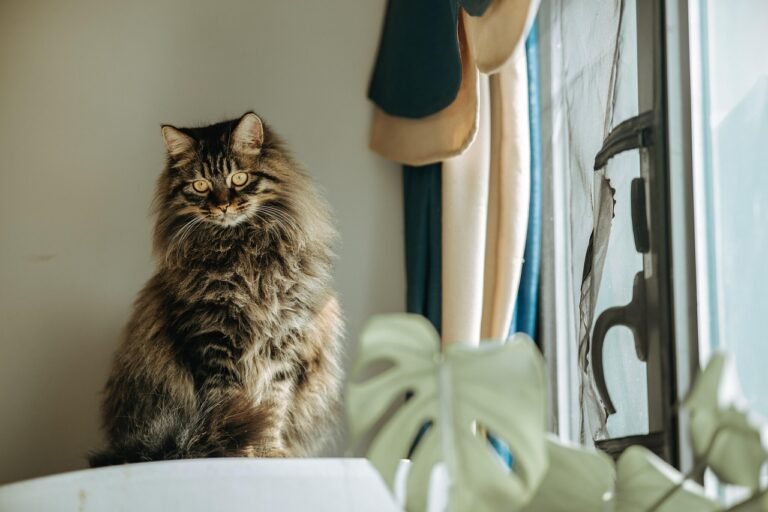
It starts around three. Always the same spot, usually the bottom of the stairs or the middle of an empty hallway, and it is not a meow. It is a long, flat, carrying howl that sounds like the cat is calling for someone. You come down, she looks at you, and it stops. You go back to bed. Twenty minutes later it starts again.
Almost everything written about this lands on one of two answers: she is old, or she wants attention. Both are worth setting aside, because the veterinary literature on night vocalisation in older cats points somewhere much more specific, and several of the things it points at are treatable.
The short version
- Night-time yowling in an older cat is a recognised clinical sign, not a personality quirk.
- Cognitive dysfunction affects an estimated 28% of cats aged 11 to 14 and 50% of cats over 15.
- In one survey of cats aged 12 to 22, excessive vocalisation was reported in 61%, and night vocalisation specifically in 31%.
- Dementia is a diagnosis of exclusion. Hyperthyroidism, kidney disease, high blood pressure, pain and failing senses all cause the same sound and several are treatable.
- High blood pressure is the one people never think of. Neurological signs appear in 15 to 40% of hypertensive cats, and it can be picked up in one appointment.
On this page
Why this is not attention seeking
The attention theory has one piece of evidence behind it, which is that the cat stops when you appear. That feels conclusive at 3am. It is not, because almost every explanation on the list below produces the same result. A disoriented cat is reassured by finding you. A cat in pain settles when something changes. A cat who cannot hear herself properly stops when she gets a response.
International Cat Care lists loud crying that is disruptive at night among the signs of feline cognitive dysfunction, alongside spatial disorientation, cats becoming trapped in corners, forgetting where the litter tray is, being awake when they would normally sleep, and a decline in grooming that leaves the coat dull or matted.
Read that list again with your own cat in mind. The yowling is rarely the only thing. It is just the only thing loud enough to wake you.
How common it actually is
Cognitive dysfunction in cats was dismissed as old age for a long time, which is roughly the title of the paper that changed it. Landsberg, Denenberg and Araujo, writing in the Journal of Feline Medicine and Surgery in 2010, put the prevalence at 28% of cats aged 11 to 14, rising to 50% of cats over 15.
On vocalisation specifically, the same review cites a survey of cats aged 12 to 22 in which excessive vocalisation was reported in 61%, with night vocalisation in 31%. It was one of the most common complaints owners raised.
Two things follow. First, if your cat is over eleven, this is common rather than strange. Second, and more usefully, the fact that it is common does not mean it is untreatable or that dementia is the answer. It means the opposite: it is common enough to have been studied properly, and the studies say to look before you conclude.
Five things to rule out before dementia
International Cat Care is explicit that cognitive dysfunction is diagnosed only after excluding other causes. Those it names are hyperthyroidism, chronic kidney disease, brain tumours, arthritis pain and high blood pressure.
| Cause | What else you might notice | How it is checked |
|---|---|---|
| Hyperthyroidism | Eating more but losing weight, drinking and urinating more, vomiting or diarrhoea, hyperactivity, coat gone unkempt or greasy | Blood test |
| High blood pressure | Disorientation, loss of balance, altered behaviour, weakness, or sudden blindness | Blood pressure cuff, plus an eye exam |
| Chronic kidney disease | Drinking much more, weight loss, poor appetite, nausea | Blood and urine tests |
| Pain, usually arthritis | Stopped jumping, sleeping in new places, reluctance with stairs, irritability when handled | Examination, sometimes x-rays |
| Hearing loss | Startles when approached, sleeps through noise, volume of all her vocalising has gone up | Examination and observation |
The blood pressure row deserves its own paragraph, because it is the one owners have usually never considered. Cornell’s Feline Health Center describes neurological changes in between 15 and 40% of hypertensive cats, including disorientation, altered behaviour and loss of balance. It also notes that at least 60% of cats diagnosed with hypertension show signs of kidney disease, and about 20% of hyperthyroid cats are hypertensive too. These conditions travel together, which is why a single test rarely settles the question.
Pain is the other one that hides. If she has also stopped getting onto the counter or the windowsill, read what it means when a cat stops jumping, because reduced jumping and night restlessness turn up together more often than either gets noticed alone. A change in where she sleeps belongs in the same picture, which we covered in why a cat starts sleeping in the bath.
What the appointment should cover
Ask for these specifically. A senior blood panel including thyroid, a urine sample, and a blood pressure reading. Blood pressure is the one most likely to be skipped in a short consultation, and it is the one that can be both serious and quickly treatable. If your cat is over eleven and yowling at night, it is reasonable to ask for it by name.
Take your four written answers, and a phone video of the behaviour if you can get one. Cats are notoriously well behaved in consulting rooms, and thirty seconds of footage is worth more than any description.
Bring the litter tray detail even if it seems unrelated. Going outside the tray, or forgetting where it is, is a documented sign of cognitive dysfunction, and it is also a sign of kidney disease and of pain getting into the tray. The combination of signs is what narrows it down.
If it is cognitive dysfunction
If the tests come back clear and the conclusion is cognitive dysfunction, it is not nothing you can do. The management is unglamorous and it works by making the world easier to navigate rather than by fixing the brain.
- Put a night light in the hallway. A disoriented cat navigating a dark house at 3am is the specific situation the yowling often comes from. This is the cheapest intervention on the list and frequently the most effective.
- Move the resources closer. Food, water and a litter tray on every floor she uses, so she never has to remember a route or climb to reach one.
- Use a tray with a low side. Old cats with sore joints avoid trays they have to climb into, and the avoidance looks like forgetting.
- Keep the routine identical. Same feeding times, same furniture, same order of events in the evening. Predictability does a lot of the work that memory used to.
- Add a late feed. A small meal just before you go to bed shifts the hunger point past the small hours for many cats.
- Ask about diet and medication. Antioxidant-supplemented diets and anti-anxiety medication both have a place, and your vet can tell you whether either fits your cat.
What not to do
Do not shout or spray water. If the cause is disorientation, fear or pain, punishment adds to the thing causing the noise. It also tends to produce a cat who yowls and then hides, which is worse for everybody.
Do not shut her out of the bedroom as the first move. It is a reasonable sleep-preservation measure later, but done before any investigation it removes the main thing you have been using to gauge how she is.
Do not decide it is age and stop there. Age is the risk factor, not the diagnosis. A fifteen-year-old cat yowling at night is statistically likely to have something specific going on, and at least four of the candidates respond to treatment.
Common questions
She stops the moment I come downstairs. Isn’t that proof it is attention?
No. Disorientation, pain and anxiety all settle when the situation changes or when the cat locates you. The stopping tells you she wanted something to change; it does not tell you what.
She is only nine. Does this still apply?
Cognitive dysfunction is uncommon that young, so the other causes move up the list. Hyperthyroidism, blood pressure and pain are all worth checking in a nine-year-old with a new night-time habit.
Could she just be bored or lonely?
Possible, particularly if another pet has recently died or the household has changed. But it is a conclusion to reach after the medical checks, not before, because the treatable causes are far more common in an older cat.
Is there anything I can do tonight?
Leave a light on in the hall, put a small meal down just before bed, and make sure there is a litter tray on the floor she sleeps on. Those three change the picture for a good number of cats without changing anything medical.
How do I know if it is getting worse?
Keep a simple log: the time, how long it lasted, and anything else that day. Progression over weeks is the thing your vet needs and the thing you will not remember accurately without writing it down.
The bottom line
An older cat calling out in an empty hallway at 3am is describing something, and the research says it is usually describable: confusion, pain, a thyroid, a blood pressure, or senses that have quietly stopped working. Dementia is a real answer and a common one, but it is the answer you reach last, after the treatable things have been ruled out. Ask for the blood pressure reading by name.
Sources
- Landsberg GM, Denenberg S, Araujo JA. Journal of Feline Medicine and Surgery, 2010. Cognitive dysfunction prevalence of 28% in cats aged 11 to 14 and 50% over 15; vocalisation frequency in cats aged 12 to 22.
- International Cat Care. Cognitive dysfunction syndrome in cats: clinical signs, conditions to exclude, and management.
- Cornell Feline Health Center. Hypertension in cats: associated diseases and the frequency of neurological signs.
- Cornell Feline Health Center. Hyperthyroidism in cats: prevalence and clinical signs.